
Don’t upgrade from HDB to private property. At least, not until you can finish that sentence with a genuine “unless.” Unless the move strengthens your balance sheet and not just your address. Unless the numbers still hold after stamp duty, CPF, and the cash you need to keep in reserve. Unless the home you buy is one the next buyer will still want a decade from now.
Because the jump from an HDB flat to a private property is rarely just a housing decision. It is a balance sheet event. Done well, it improves your lifestyle, strengthens your long-term asset position, and creates better optionality for the next move. Done poorly, it can lock up liquidity, compress cash flow, and leave you holding an expensive asset with weak resale depth.
That is why understanding how to upgrade from HDB to private property starts with strategy, not project viewing. Before looking at brochures, floor plans, or launch prices, you need to know what you can redeploy, what you must preserve, and what kind of private property actually fits your next five to ten years.
How to upgrade from HDB to private property without overreaching
Most upgraders focus on the headline question: can we afford the condo? The better question is whether the move remains efficient after stamp duties, loan limits, CPF usage, renovation, temporary housing, and future holding power are taken into account.
The first layer is your current HDB equity. This means understanding your likely sale price, outstanding loan, CPF used plus accrued interest, selling costs, and the cash proceeds left after completion. Many owners overestimate what is available because they focus on market value rather than usable proceeds. That gap matters. It affects down payment, emergency reserves, and whether the move is merely possible or actually prudent.
The second layer is financing. Your income profile, age, existing obligations, and loan tenure shape how much debt you can carry comfortably. Banks may approve a certain amount, but approval is not the same as strategic affordability. A disciplined upgrader keeps enough room for rate movement, family expenses, and future flexibility.
The third layer is sequencing. Whether you sell first or buy first reshapes your capital position, your negotiating strength, and your risk through the transition. The right path depends on liquidity, risk appetite, and whether temporary accommodation is acceptable — there is no universal rule, which is why it deserves a closer look on its own.
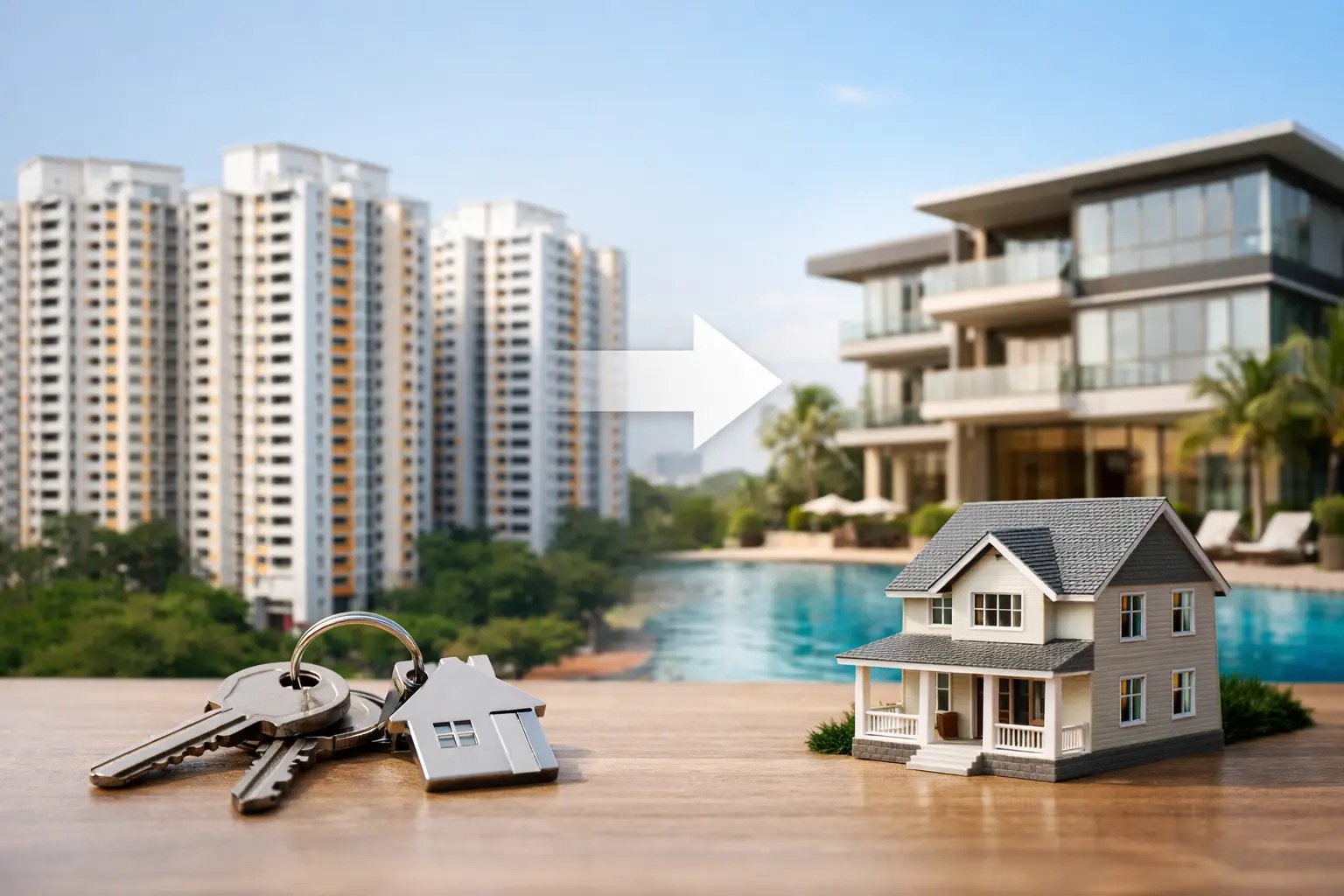
Start with your upgrade thesis
A private property should solve for more than aspiration. It should answer a clear strategic brief.
For one family, the objective may be better school access and a stronger owner-occupier asset in a district with tighter future supply. For another, it may be moving from a fully paid HDB into a manageable private home while preserving liquidity for business or retirement planning. For a younger couple, the move may be about entering the private market early enough to participate in a different resale and rental profile over the next decade.
Without that thesis, buyers tend to drift toward projects that are simply more marketable in the moment. That is where overpayment often begins. A polished launch story can distract from entry price, competition, lease profile, unit stack quality, and exit demand.
Private property is not a single category. A mass-market suburban condo, a city fringe project, and a boutique freehold development do not behave the same way over time. Your selection has to fit your holding horizon, family needs, and exit logic.
The real cost of upgrading from HDB
The visible costs are straightforward. There is the purchase price, Buyer’s Stamp Duty, legal fees, valuation fees, and renovation. But the hidden costs often shape the outcome more than buyers expect.
One is the cost of poor timing. If you sell your HDB into a softer micro-market while buying private property at an aggressive entry price, the spread works against you twice. Another is the cost of idle cash or forced bridging. If your sequencing is inefficient, you may carry unnecessary financing pressure or lose negotiating strength.
Then there is opportunity cost. If too much of your net worth gets concentrated into a private property with weak growth drivers, you may own a nicer home but a less effective asset. Upgrading should improve both living quality and capital efficiency where possible. If it only achieves the first, it deserves more scrutiny.
For many owners in Singapore, CPF also plays a central role. Funds used for the next purchase can lower immediate cash outlay, but they should not be treated as free capital. The way CPF is deployed affects retirement adequacy, liquidity, and future planning. Good structuring is not about maximizing usage blindly. It is about using the right mix of CPF and cash for resilience.
Should you sell first or buy first?
This is one of the most important judgment calls in the entire process.
Selling first gives you capital clarity. You know your exact proceeds, can size your purchase with precision, and reduce the risk of carrying two properties through a stressed timeline. For many HDB upgraders, this is the cleaner route. It is especially sensible if your affordability is closely tied to HDB sale proceeds.
Buying first can make sense if you have strong liquidity, a very specific target market, or a need to secure a rare unit before releasing your current home. But the margin for error narrows. You need to account for loan exposure, stamp duty implications, and a realistic HDB disposal timeline. Confidence without structure is expensive.
This is where transaction choreography matters. Upgrading is not just about valuation and financing. It is about aligning option periods, completion dates, potential extensions, and fallback scenarios. Strong outcomes often come from quiet operational precision rather than dramatic negotiation.

How to choose the right private property
The wrong condo can set you back years. Not because it is unlivable, but because it becomes difficult to exit well.
A sound private upgrade typically sits at the intersection of three things: livability, entry discipline, and future demand. Livability covers layout efficiency, usable size, connectivity, and fit for your family’s next phase. Entry discipline means not overpaying relative to nearby alternatives, historical transactions, and project-level fundamentals. Future demand concerns who will want this unit from you later, at what price point, and why.
That last question is where many upgraders need a more analytical lens. A beautiful unit is not automatically a strong asset. You want to understand transaction velocity, competing supply, tenant profile if relevant, maintenance burden, and how the development sits within its district’s broader price hierarchy.
This is the work BuySafe was built to do. It reads the signals that quietly decide resale depth and exit liquidity — transaction velocity, competing supply, tenant demand, and how a project prices against realistic substitutes — and scores the safer buys in each area. It turns future demand from a guess into something you can see before you commit, not after.
This is also why project selection should not be driven by tenure alone, or by simplistic labels such as new launch versus resale. Sometimes a resale private property offers a better basis of value, stronger space efficiency, and more visible price support. Sometimes a newer project brings stronger future demand because of layout relevance and locational shifts. It depends on the numbers, not the narrative.
Common mistakes when moving from HDB to private property
The most common mistake is treating the move as a reward rather than a portfolio decision. Emotion is natural, but when it leads the process, buyers tend to stretch for the wrong reasons.
The next mistake is underestimating cash requirements. Even financially strong households can feel squeezed if too much liquidity is committed upfront. A property should not leave the rest of your financial life brittle.
Another error is buying a project with weak exit logic. This often happens when the unit was sold on mood, facilities, or launch excitement rather than evidence of long-term demand. In an ordinary market, average assets can look acceptable. In a tighter market, quality differentials widen fast.
Finally, some upgraders plan only for entry and not for the next move. A private property bought today should still make sense when you review it five or ten years from now. Can it be sold efficiently? Does it appeal to the next buyer pool? Does the quantum remain liquid enough for your market segment? Good upgrading keeps the future exit in view from day one.
A better framework for the upgrade
If there is one principle worth holding, it is this: move only when the next property improves your position, not just your address.
That means modeling your sale proceeds conservatively, stress-testing monthly commitments, and selecting a private property with clear reasons for long-term demand. It also means accepting that the best upgrade is not always the biggest one. Sometimes the right move is to step into a private asset class at a measured quantum, preserve flexibility, and let time do more of the work.
At The Property Collective, that is usually where the conversation begins — with scenario planning and a BuySafe read on the shortlist, not sales language. Because the best upgrade paths are rarely improvised. They are structured.
If you are considering the move, give the numbers enough respect. Property progression tends to reward patience, precision, and calm execution far more than urgency ever will.
Thinking about the HDB-to-private move? We will model your equity, CPF, loans and exit, and tell you honestly if now is not the time.
Keep reading
Related notes.
More flats are coming. What the 2026 to 2028 supply wave does to HDB resale prices.
HDB resale prices have fallen two quarters in a row, and the flats reaching their five-year MOP rise from about 13,500 this year to 19,500 in 2028. History says supply caps the upside but demand sets the direction. Here is where the softness lands first, and what it means if you are selling to upgrade.
Downgrading from a condo to HDB: what it actually unlocks, and what it costs.
Downgrading from a condo to HDB in Singapore no longer means a 15-month wait, and for most Singapore Citizens it now comes with zero ABSD. What eligibility actually requires, the CPF refund maths, and a worked example of what the move genuinely frees up.
Six quarters of muted growth: is this the upgrader’s window, or a trap?
Private prices have grown at 1% or less for six straight quarters, and HDB resale has now fallen two quarters in a row. That combination is unusual, and it changes the arithmetic of upgrading in a way most sellers have not noticed yet.
Not advice. This is general commentary for information only. It is not financial, investment, legal or tax advice, and not a recommendation to buy, sell or hold any property. Your figures depend on your own circumstances.
Do your own sums. CPF refunds, accrued interest, stamp duties and loan limits change and are specific to each household. Confirm your numbers with HDB, CPF, IRAS and your bank before committing.
Independent. The Property Collective is not affiliated with, endorsed by, or connected to HDB, CPF, IRAS or any government agency.