
Property cycles rarely move in a straight line. They dip, find a floor, and recover — a rough V. The mistake most buyers make is chasing the right-hand side of the V, when prices are already climbing and the easy gains are gone. The discipline is to position near the bend instead.
What the V-shape really is
A V-shape isn’t a prediction that prices will halve and double. It’s a simple observation: demand cools, transactions slow, prices soften or stall — and then, as supply is absorbed and financing eases, the market turns back up. The buyers who do best aren’t the ones who time the exact low. They’re the ones who enter while sentiment is still cautious, with enough margin that they’re fine even if the bend takes longer than hoped.
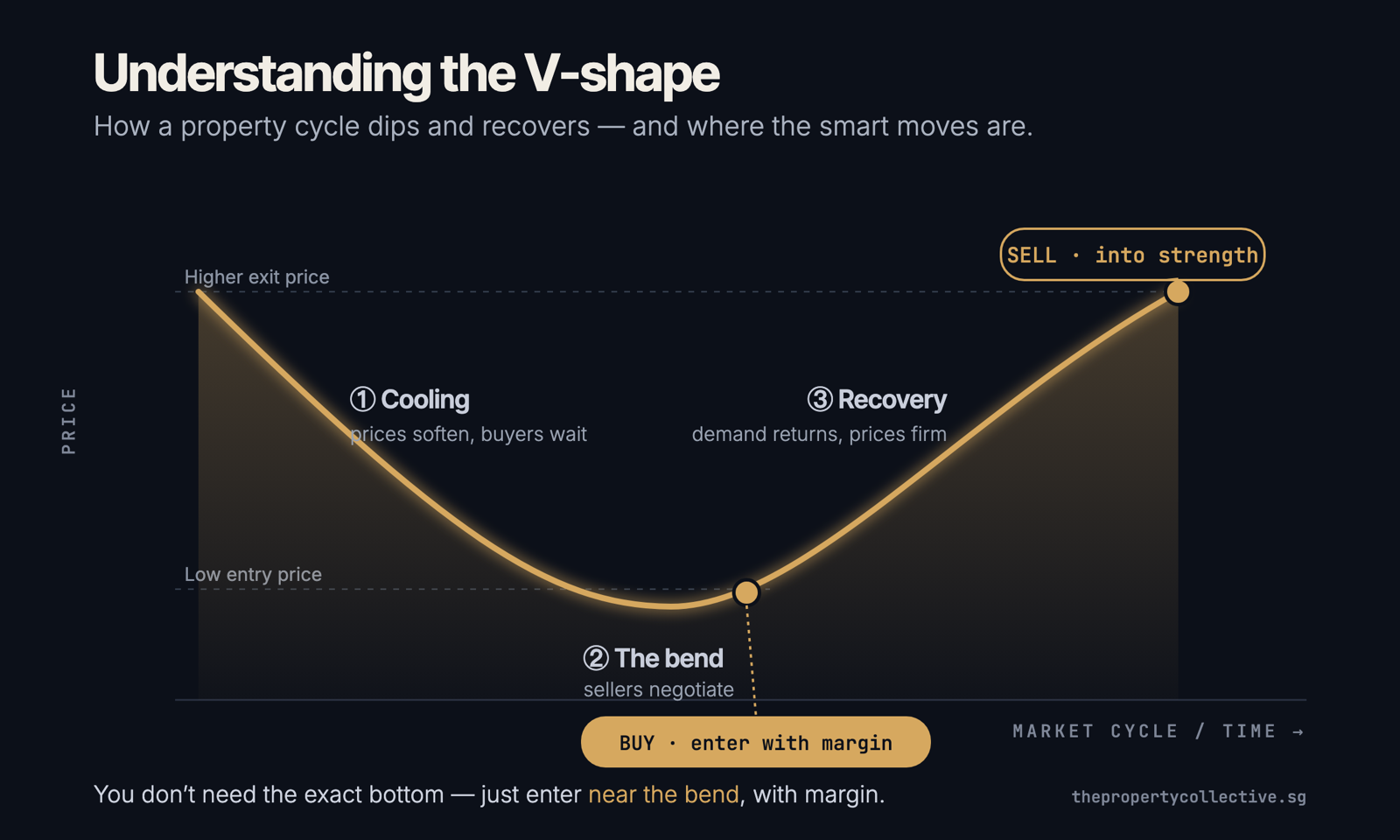
Three phases, one plan
When competition is thin and sellers are realistic, you buy on evidence, not hype — and you negotiate. The aim isn’t the perfect bottom; it’s a sensible entry with room for error.
Stress-test the hold so a flat market for two or three years doesn’t force your hand. Margin of safety is what lets you wait for the right-hand side of the V.
Sell into the recovery, not after it. The goal is to be the one transacting while demand is firm — and into a segment with depth, so the exit is clean.
“Is it the right time?” is the wrong question
Buyers freeze on that question because it can’t be answered — nobody rings a bell at the bottom. The better question is whether you can enter with enough margin that the timing doesn’t have to be perfect. That shifts the decision from prediction to structure, which is the only part you actually control. We unpack this fully in how to assess condo entry timing.
Entering near the bend, in practice
A cooling or stalling market is where the bend usually sits. Competition thins, sellers become negotiable, and mispricing appears at the unit level. That’s the moment to buy a quality asset at a rational spread — provided your financing and holding power are sound. Buying against the mood only works when those are already in place; otherwise you’re not being early, you’re just taking on more risk.
Positioning the exit
The exit is decided at entry. Choose a project with broad, durable demand and real resale depth, and the right-hand side of the V is a clean sale into a firm market. Choose a thin, hard-to-sell asset and even a recovery won’t rescue your timing. For resale private condos, BuySafe scores exactly this — real, like-for-like growth and how cleanly a project exits, across 140,000+ publicly available URA transactions and 3,000+ projects. Know the exit before you enter.
Related: how to assess condo entry timing →
Timing a cycle is about structure, not luck. We map the entry, the hold and the exit with you, so the V works for you, not against you.
Keep reading
Related notes.

Inherited a property in Singapore? Here is the process, the tax you don’t owe, and the one you quietly do.
What to do if you inherit a property in Singapore: no estate duty, no stamp duty on the inheritance itself and no CPF refund on the deceased’s savings, but HDB runs a 6-month and a 12-month clock after probate, a landed home cannot pass to a foreign heir without approval, and the property joins your ABSD count on whatever you buy next.
Divorce and your property in Singapore: what actually happens to the flat, the CPF, and the next purchase.
A divorce court order can move the matrimonial home to one spouse without any stamp duty. But the CPF refund is a default the Court can vary, a subsidised flat still carries a resale levy, and a replacement home bought before the old one is sold can trigger ABSD anyway. Here is how property, CPF and tax actually work through a Singapore divorce.
Mortgagee sales just hit a five-year high. Here is what actually happens if you can’t pay your mortgage.
What happens if you can’t pay your mortgage in Singapore: 216 mortgagee sale listings hit the market in 1H 2026, a five-year high. The real sequence is slower and more negotiable than the auction headlines suggest, for both HDB and bank loans, if you act while the loan is still current.
Not financial or tax advice. General information about the Singapore property market. It is not financial, investment, tax, mortgage or legal advice, and not a recommendation to buy, sell or hold any property. Your position depends on your own circumstances.
Rules change. ABSD, TDSR, loan-to-value and CPF rules are set by IRAS, MAS, HDB and the CPF Board and can change without notice. Guidance here is general, as at 2026 — confirm your position with the relevant authority and your own advisers before acting.
Independent. The Property Collective is not affiliated with, endorsed by, or connected to any government agency. BuySafe analyses resale private condos using historical, publicly available URA transaction data and does not cover new launches; past performance is not indicative of future results.