
There’s a well-documented quirk in how people value things: the moment we own something, we price it higher than the market will. Economists call it the endowment effect. In property — the biggest asset most people own — it’s one of the most expensive biases there is.
What the endowment effect is
In experiments, people asked to sell something they were just given demand far more than buyers will pay for the identical item. Ownership itself inflates the price. With a home, that instinct is amplified by memory and emotion: this is where your family grew up, where you renovated, where you planned to make a gain. So the number in your head drifts above the number the market is actually printing.
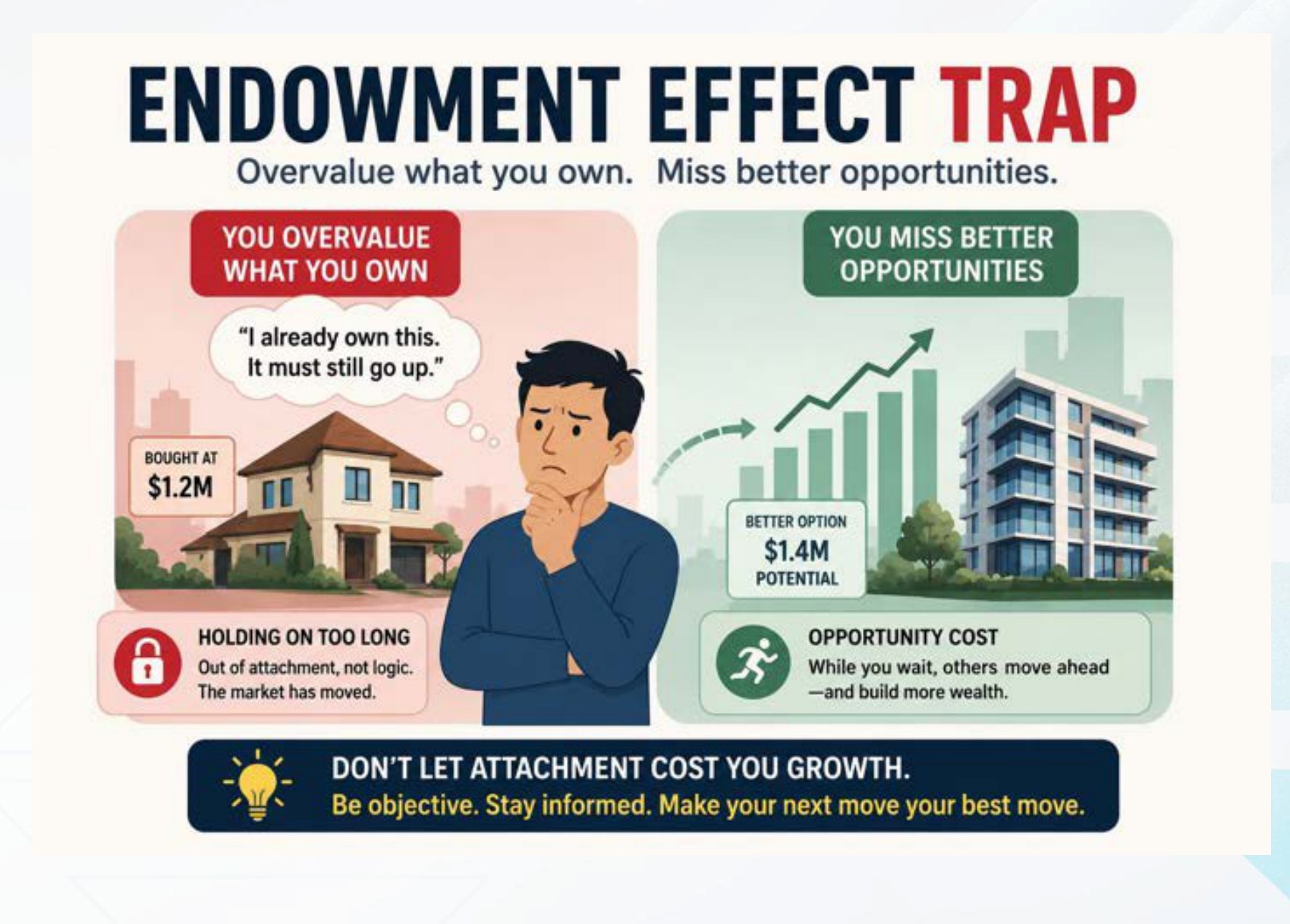
Two traps, one bias
“I already own this, it must keep going up.” You price off the peak and your own story — not today’s transactions — so the flat or unit lists high and sits.
While you hold out for a number the market won’t pay, the stronger opportunity — a better-located, more liquid asset — gets away. The real loss is the move you didn’t make.
How it shows up in a stalling market
In a rising market, the bias is harmless — prices catch up to optimistic sellers eventually. In a flat or cooling market, it bites. Buyers have alternatives and patience; an overpriced listing doesn’t look bold, it looks stale. Weeks pass, the price gets cut, and the eventual sale often lands below where a realistic price would have closed months earlier. Holding on didn’t protect the value — it eroded it.
Sell high, buy low — the discipline
The antidote is almost a cliché, and almost nobody follows it: sell into strength, buy into weakness. If your asset has run hard and is now plateauing, that strength is your window to exit well — not a reason to hold for one more leg up that may not come. And the proceeds buy more when you redeploy them into a segment that hasn’t yet re-rated. The discipline is acting on the cycle, not on your attachment to it.
The endowment effect doesn’t cost you when you buy. It costs you when you refuse to sell — and the better move passes you by.
How to debias the decision
- Price off transactions, not memory. What did comparable units actually close at in the last few months — adjusted for floor, size and condition — not what your neighbour is asking?
- Cost the opportunity. Put a number on the better move you’d make with the proceeds. Holding has a price; name it.
- Get a second, disinterested read. You can’t easily debias yourself. An adviser — or hard data — with no attachment to your home will see the number you can’t.
That last point is where evidence beats instinct. For a resale private condo, BuySafe gives an objective, like-for-like read across 140,000+ publicly available URA transactions and 3,000+ projects — what your project has genuinely done, and how cleanly it exits — so the decision rests on the market, not on what you wish your home were worth. Know the exit before you enter.
Next: the V-shape strategy: enter low, exit strong →
A second, objective read is the cheapest insurance against your own bias. We pressure-test the price and the move with you, on the data.
Keep reading
Related notes.

Inherited a property in Singapore? Here is the process, the tax you don’t owe, and the one you quietly do.
What to do if you inherit a property in Singapore: no estate duty, no stamp duty on the inheritance itself and no CPF refund on the deceased’s savings, but HDB runs a 6-month and a 12-month clock after probate, a landed home cannot pass to a foreign heir without approval, and the property joins your ABSD count on whatever you buy next.
Divorce and your property in Singapore: what actually happens to the flat, the CPF, and the next purchase.
A divorce court order can move the matrimonial home to one spouse without any stamp duty. But the CPF refund is a default the Court can vary, a subsidised flat still carries a resale levy, and a replacement home bought before the old one is sold can trigger ABSD anyway. Here is how property, CPF and tax actually work through a Singapore divorce.

Mortgagee sales just hit a five-year high. Here is what actually happens if you can’t pay your mortgage.
What happens if you can’t pay your mortgage in Singapore: 216 mortgagee sale listings hit the market in 1H 2026, a five-year high. The real sequence is slower and more negotiable than the auction headlines suggest, for both HDB and bank loans, if you act while the loan is still current.
Not financial or tax advice. General information about the Singapore property market. It is not financial, investment, tax, mortgage or legal advice, and not a recommendation to buy, sell or hold any property. Your position depends on your own circumstances.
Rules change. ABSD, TDSR, loan-to-value and CPF rules are set by IRAS, MAS, HDB and the CPF Board and can change without notice. Guidance here is general, as at 2026 — confirm your position with the relevant authority and your own advisers before acting.
Independent. The Property Collective is not affiliated with, endorsed by, or connected to any government agency. BuySafe analyses resale private condos using historical, publicly available URA transaction data and does not cover new launches; past performance is not indicative of future results.