A glossy showflat can hide a weak asset. That’s why it pays to analyse a private condo project properly — long before you sign an option or write a cheque. In the private market, the gap between a pleasant purchase and a genuinely safe one usually comes down to a few quiet things: a disciplined entry price, the competition coming up nearby, what the land cost, the unit mix, and who is likely to buy from you later.
Most buyers don’t lose money because they picked the wrong lobby or the wrong kitchen finish. They lose flexibility because they bought into the wrong project logic. A place can feel right and still perform poorly over a five- to ten-year hold. That gap is where analysis earns its keep.
What project analysis should actually measure
Many buyers think it means checking whether a development is near an MRT, whether the developer is well known, and whether the psf looks fair against nearby listings. Those are baseline checks, not a full decision.
A proper review asks harder questions. Are you getting in at a price that still leaves room for the next buyer? Is the project up against too many similar launches in the same pocket? Does the unit mix support healthy demand, or is it stuffed with investor-sized units that could crowd the resale market later? If it’s leasehold, is the discount to nearby freehold projects wide enough for the tenure risk you’re taking?
The aim isn’t to find a perfect project — there’s no such thing. It’s to know whether the project gives you enough downside protection and enough future liquidity for how long you plan to hold.
Start with the entry price, not the brochure
Entry price is the first filter, because every later outcome builds on it. Buyers often fixate on whether a launch will sell well. That matters — but it’s not the same as asking whether your unit was bought at a level that still leaves room to grow.
A project can be slickly marketed, heavily subscribed, and still leave late buyers exposed. If a launch has already nudged its prices up over several phases, the late entrant may be paying for the developer’s margin rather than buying value. Whether that’s the case usually shows up not in the brochure, but in the signals around the project.
Read the signals around the project, not just the project itself
The unit and the facilities are what you see on a viewing. The things that quietly decide whether it’s a safe buy mostly sit outside the showflat. Four are worth reading carefully before you commit.
- Nearby transactions. Asking prices are hope; transacted prices are evidence. Look at what comparable units in the project and the streets around it have actually sold for — adjusted for size, floor and condition — and how often they change hands. Thin, sporadic deals point to a shallow market and a harder exit; steady, broad-based transactions point to real demand you can lean on when it’s your turn to sell.
- The URA Master Plan. Refreshed roughly every five years — the current version is gazetted as Master Plan 2025 — it sets out what can be built where, and how densely. New MRT lines, parks, schools and a transformation story can lift a pocket over the years. But an empty plot next door zoned for a tall block, a “white site,” or a plot ratio that has just been raised is future supply pointed straight at your future buyer.
- The developer’s land bid. What a developer paid for the land sets its breakeven — and, roughly, the floor under launch prices. Win land aggressively and there’s less room to price attractively, so late buyers can end up underwriting the margin. Land bids hit fresh records through 2025 and 2026, which is exactly why entry discipline matters more now, not less.
- Upcoming land bids and en-bloc sites. Future Government Land Sales (GLS) tenders and collective sales nearby preview both your competition and the price the next launches will anchor to. A strong winning bid nearby can pull your resale value up; a wave of new sites can flood the area with fresher alternatives and make your exit more price-sensitive.
Read together, these four tell you something a showflat never can: whether the market structure around the project is working for you or against you.
Micro-location beats district branding
A district’s reputation is useful, but it’s far too broad to drive a capital decision on its own. Two projects in the same district can turn out very differently, because micro-location shapes buyer behaviour far more directly than a postal code does.
Walking distance to transit is one layer. Just as important are the quality of that walk, traffic noise, whether you sit next to industrial or institutional uses, school demand, everyday retail, and the general feel of the immediate streets. Some buyers pay for a district name while overlooking that their project sits in a less favoured pocket within it.
This matters even more at resale. Your future buyer is rarely comparing your unit against the whole island. They’re comparing it against a small set of alternatives within a narrow area and budget. If the nearby competing projects offer a cleaner location, your exit can become far more price-sensitive than you expected.
Unit mix can support or weaken resale demand
Not all demand is equal, and one of the more overlooked parts of project analysis is the make-up of the development itself.
A project dominated by compact one- and two-bedders may enjoy strong early investor interest — but that same profile can create a crowded resale field later, especially when many owners try to exit around the same time. Developments with a more balanced spread of practical family units often benefit from a wider buyer pool and less direct internal competition.
This isn’t an argument against smaller units. It’s an argument for matching unit type to how deep the local market really is. In some city-fringe and central spots, smaller units stay highly liquid because rental demand and affordability support them. In other areas, they become interchangeable inventory. The simple question: when you eventually sell, how many near-identical units will you be competing against — inside the project and just outside it?
Developer quality matters — but not the way buyers think
Buyers often treat a developer’s brand as a shortcut for safety. There’s some truth in that — experienced developers tend to execute better, plan layouts more efficiently, and read pricing with more precision.
Still, brand alone isn’t enough. A strong developer can launch into a difficult pocket; a lesser-known one can deliver a well-priced project with excellent fundamentals. The better question is whether the developer’s pricing, unit planning and positioning are aligned with what the location can realistically support. Execution matters more than prestige — a famous name doesn’t immunise a project against being overpriced.
Rental demand and owner-occupier demand aren’t the same thing
Many buyers assume that if a project rents well, it will resell well. Sometimes that’s true. Often it’s only partly true.
Rental demand can cover your holding costs and put a useful floor under values, but resale demand runs on different motivations. Families care about layout, schools, daily convenience and long-term liveability. Investors care more about quantum, yield and tenant profile. A project tuned for one audience can be less compelling to the other. So be clear about your likely exit buyer from day one: if it’s an upgrader family, your analysis should lean less on short-term rental strength and more on practical unit sizes, family-friendly positioning, and affordability within that segment.
The right project depends on your balance sheet
No project should be judged in isolation from your own finances. The same condo can be sensible for one household and a poor move for another.
A buyer with strong cash, a long holding horizon and no pressure to sell can absorb certain trade-offs — say, a slower-growth project with solid defensive qualities. A stretched buyer has far less margin for error, so entry discipline and resale depth matter even more, because the cost of being stuck in a mediocre asset is higher. This is where proper advice changes the conversation. At The Property Collective, a project is never judged as a beauty contest between launches — it’s tied back to your equity, your CPF usage, your financing, and your likely upgrade or exit timing. The project is only right if it fits the bigger plan.
A three-step way to get from the whole market to one safe buy
All of this can feel like a lot to hold in your head. In practice it comes down to three steps — the same sequence we run with clients, with BuySafe doing the heavy lifting in the middle.
From the whole market to one safe buy
Start with your own constraints, not a launch: your budget and the loan and CPF behind it, the locations that fit your life, the unit type your future buyer will want, and how long you’ll hold. This turns the whole market into a focused shortlist.
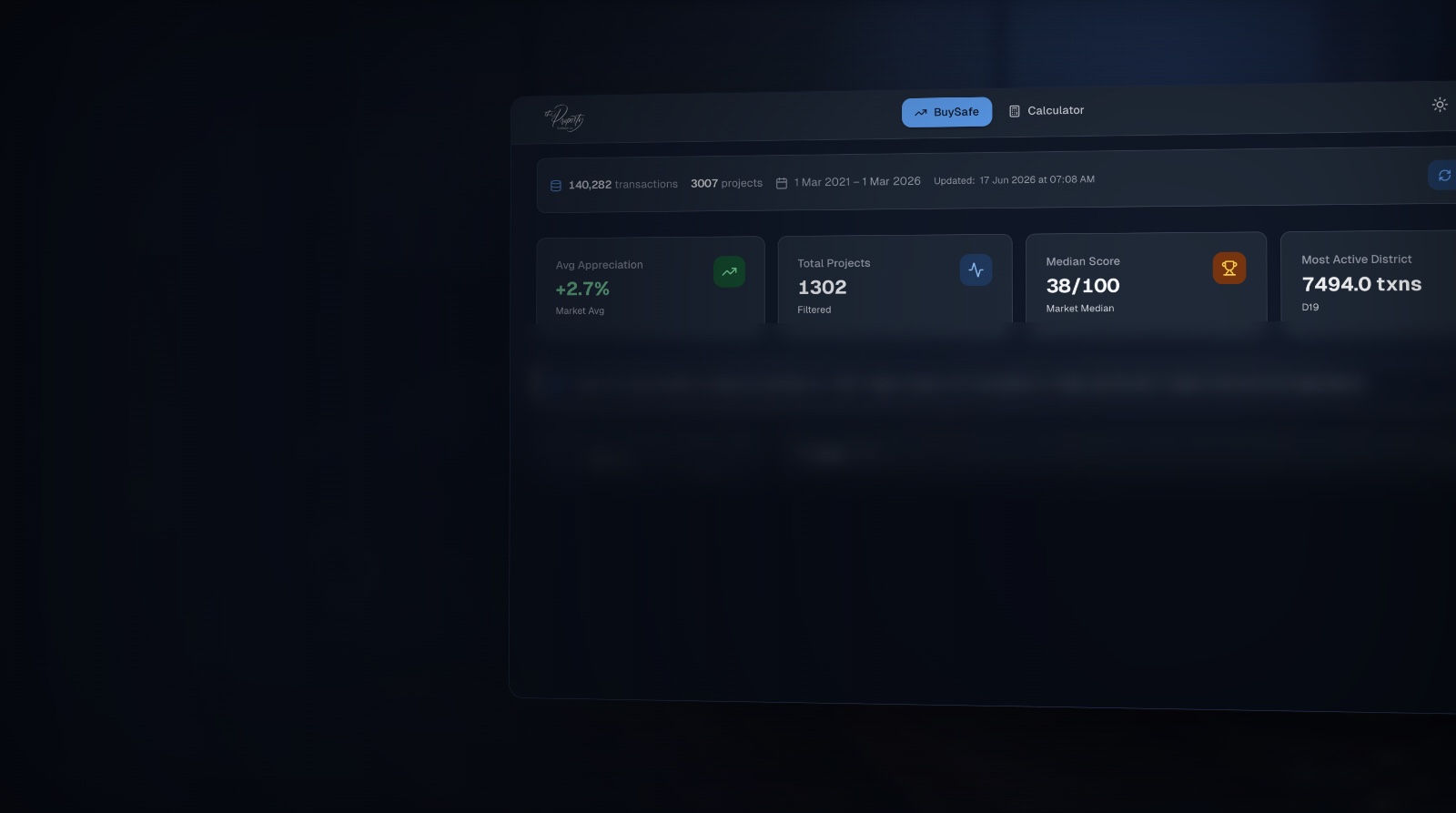
BuySafe covers resale private condos. For a resale shortlist it scores each project directly; for a new launch, it reads how comparable nearby resale projects have actually performed — the market your launch will one day sell into. Either way: real, size- and floor-adjusted growth across 140,000+ URA transactions and 3,000+ projects, as one 0–100 score. Real appreciation weighs most; resale depth and price next. Thin data shows blank, not a guess.
A high score is necessary, not sufficient. Check the front-runners against the four signals — transactions, Master Plan, land cost, upcoming land bids — and your own balance sheet: equity, CPF, financing and exit timing. The safe buy scores well, sits in a supply backdrop you can live with, and fits your next move.
BuySafe isn’t a public login; we walk you through it on your own shortlist, so the score becomes the start of a decision rather than the end of one.
A disciplined checklist beats excitement
The market will always give you reasons to rush — a hot launch, a narrowing ballot, a persuasive sales story, the fear of missing the next leg up. None of them remove the need for discipline.
Good project analysis isn’t about predicting the future perfectly. It’s about cutting avoidable mistakes. It asks whether the project is being bought at the right price, in the right pocket, with the right supply backdrop, for the right exit buyer, and within the right financial plan. That may sound restrained. It should be — property is too big a line item for impulse. A well-chosen condo does more than house you today; it protects your capital and keeps your next move within reach. Know the exit before you enter.
Next: how to avoid overpaying for a condo →
A high BuySafe score is the start, not the finish. We pressure-test the project, the supply backdrop and your own numbers before you commit.
Keep reading
Related notes.

Inherited a property in Singapore? Here is the process, the tax you don’t owe, and the one you quietly do.
What to do if you inherit a property in Singapore: no estate duty, no stamp duty on the inheritance itself and no CPF refund on the deceased’s savings, but HDB runs a 6-month and a 12-month clock after probate, a landed home cannot pass to a foreign heir without approval, and the property joins your ABSD count on whatever you buy next.

Divorce and your property in Singapore: what actually happens to the flat, the CPF, and the next purchase.
A divorce court order can move the matrimonial home to one spouse without any stamp duty. But the CPF refund is a default the Court can vary, a subsidised flat still carries a resale levy, and a replacement home bought before the old one is sold can trigger ABSD anyway. Here is how property, CPF and tax actually work through a Singapore divorce.

Mortgagee sales just hit a five-year high. Here is what actually happens if you can’t pay your mortgage.
What happens if you can’t pay your mortgage in Singapore: 216 mortgagee sale listings hit the market in 1H 2026, a five-year high. The real sequence is slower and more negotiable than the auction headlines suggest, for both HDB and bank loans, if you act while the loan is still current.
Not financial or tax advice. This is general information about the Singapore private property market. It is not financial, investment, tax, mortgage or legal advice, and not a recommendation to buy, sell or hold any property. Your position depends on your own circumstances.
Rules change. Master Plan, Government Land Sales, ABSD, loan and CPF rules are set by the URA, IRAS, MAS, HDB and the CPF Board and can change without notice. Figures here are general guidance as at 2026 — confirm your exact position with the relevant authority and your own advisers before committing.
Independent. The Property Collective is not affiliated with, endorsed by, or connected to the URA, IRAS, MAS, HDB, the CPF Board or any government agency. BuySafe analyses resale private condos using historical, publicly available URA transaction data and does not cover new launches; past performance is not indicative of future results.