On 16 September the US Federal Reserve raised its benchmark rate for the first time since 2023, a unanimous quarter-point move to 3.75–4% that CNA notes came with a clear signal: more could follow. It took one week for the market to decide the signal was real. After Fed governor Michael Barr said further adjustments are likely to be needed and a closely watched S&P Global survey showed inflation pressure at its highest since October 2022, futures markets on 23 September priced a 73% chance of another hike at the 27–28 October meeting, per CME FedWatch data reported by CNBC.
Singapore does not import US policy rates directly. But it imports their gravity, and the pull has already started: fixed home loan rates here moved up before the Fed did, and Maybank has raised its year-end SORA forecast by a full third. Two groups need to read this cycle carefully: anyone whose lock-in ends within a year, and anyone waiting on the sidelines for a better moment to buy.
Sources: CME FedWatch via CNBC (23 Sep 2026); The Straits Times (17 Sep 2026); CNA (18 Sep 2026).
Why does the market suddenly expect another hike in October?
Because the data and the Fed’s own voters both pointed the same way in the space of one day. On 23 September, Fed governor Michael Barr, a voter, said in prepared remarks that in his base case further policy adjustments are likely to be needed to bring inflation back to target, adding that the committee had been out of position on rates. The same morning, S&P Global’s flash surveys showed US services activity at a 59-month high and its overall inflation gauge at the highest level since October 2022, driven by fuel, transport and wage costs. Two-year Treasury yields jumped more than 13 basis points to 4.9%, and FedWatch odds of an October hike hit 73%.
The committee’s own projections lean the same way. CNA reports that 16 of 18 policymakers expect the federal funds rate to end the year above its current level, which implies at least one more quarter-point move. Only two expect no further increase this year. None of this is a certainty: mortgage brokers interviewed by CNA caution that policymakers’ views shift with conditions, and DBS’s chief economist told The Straits Times a market shock could force the Fed to change focus entirely. But the base case, priced and stated, is now more tightening, not less.
How does a Fed hike actually reach a Singapore mortgage?
Indirectly, with a lag, and never one for one. MAS does not set interest rates at all: it manages inflation through the exchange rate, and it has already tightened twice this year, in April and July. That leaves Singapore’s domestic interest rates to follow the global tide, as The Straits Times puts it. The benchmark that matters for most floating-rate mortgages is SORA, which is computed from actual overnight interbank transactions in Singapore. When US rates rise, funding costs rise, and SORA tends to drift up with them rather than jump.
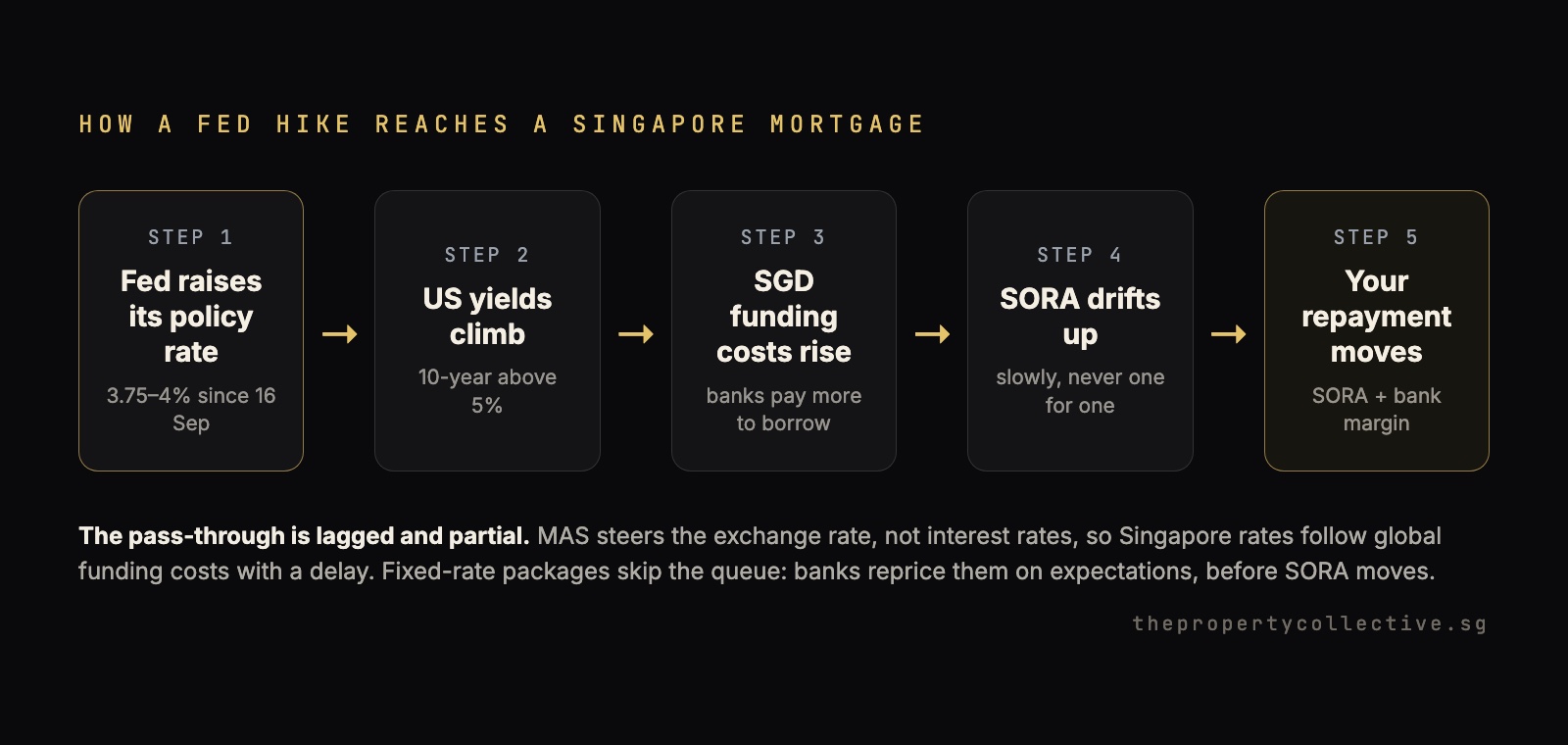
The drift is visible but still gentle. The compounded three-month SORA has edged up from 1.1797% at the start of the year to 1.2007% on 16 September, per The Straits Times, with the one-month at 1.2479%. Those are still low numbers. The change is in the forecasts: Maybank economist Chua Hak Bin now sees three-month SORA at 1.6% by end-2026 and 1.85% by end-2027, up from 1.2% and 1.3% before the hike. That is roughly a 0.4 percentage point climb from today’s level within 15 months, if the Fed keeps going.
3-month compounded SORA, actual and forecast. Sources: The Straits Times (actuals as reported 17 Sep 2026; forecasts by Maybank’s Chua Hak Bin).
Forecasts are Maybank estimates, not MAS guidance, and assume the Fed keeps tightening.
Sources: CNBC (23 Sep 2026), The Straits Times (17 Sep 2026), CNA (18 Sep 2026). FedWatch odds are market-implied probabilities, not forecasts.
| Indicator | Where it stands | Why it matters here |
|---|---|---|
| Fed funds target | 3.75–4.00% after the 16 Sep hike | First increase since 2023, passed unanimously |
| Next FOMC, 27–28 Oct | 73% hike odds priced | A second move would confirm a cycle, not a one-off |
| 3M compounded SORA | 1.2007% on 16 Sep, from 1.1797% in Jan | The benchmark under most floating-rate mortgages |
| Maybank SORA forecast | 1.6% end-2026 · 1.85% end-2027 | Raised by a third after the hike |
| US 10-year yield | Above 5%, highest since 2007 | Long-term funding costs push SG fixed rates up |
| SG fixed mortgage rates | Up 0.10–0.25pp before the hike | Banks price expectations, not just today’s rates |
Your lock-in ends within a year. What should you do?
Get your repricing and refinancing quotes now, not after October. That is the near-unanimous advice from the mortgage professionals CNA interviewed. SingCapital’s Alfred Chia put it directly: home owners whose lock-in periods are ending should review their loans now rather than wait for another increase. The reason is that fixed-rate packages price in expectations, not just current rates. Banks had already lifted fixed rates by 0.10 to 0.25 percentage points before the Fed moved, according to MortgageWise’s Darren Goh, and Mortgage Master’s David Baey expects fixed rates to rise by slightly over half a percentage point as the cycle proceeds. Every week of waiting shops from a slightly worse menu.
Monthly principal and interest at three illustrative rates. Our calculation; fees and package structures excluded.
The 2.0% to 2.5% step is $248 a month, about $8,900 over a three-year lock-in.
You are on the fence about buying. Does a hiking Fed mean wait?
Not by itself. Rates in Singapore are a cash-flow variable, not a reliable price signal: the market you would be buying into is already moderating for its own reasons, as we covered in the cooler market read, and Singapore prices have historically not fallen simply because US rates rose. What a hiking cycle does change is your affordability arithmetic, in your favour as a discipline. Banks already stress-test your loan at rates well above today’s under the TDSR framework, so a buyer who clears the test at the stressed rate is, by construction, buying with a buffer against exactly this cycle.
The honest way to use this moment: budget at the stressed rate rather than the teaser rate, favour homes whose resale depth you have checked rather than stretching for the marginal unit, and treat the difference between a 1.2% and a 1.6% SORA world as about $200 a month per million borrowed, not as a reason to abandon a well-planned purchase. Waiting has costs too: if the Maybank path is right, the loan you delay into 2027 prices off a higher curve, and fixed packages will have repriced long before SORA peaks. The deciding question is not the next FOMC meeting. It is whether the specific property clears your exit test, which is the analysis rate sensitivity cannot answer on its own.
Sources
- CNBC: Market sees next Fed hike in October, following Barr comments and hot inflation reading (23 Sep 2026)
- The Straits Times: US aligns inflation policy with other central banks like Singapore’s with first rate hike since 2023 (17 Sep 2026)
- CNA Explains: Should Singapore home owners review their mortgages after the Fed’s rate hike? (18 Sep 2026)
Refinancing in the next year, or deciding whether to buy before rates move again? We read your loan, your timeline and your shortlist against the numbers, not the noise. The mortgage is half the decision; the exit is the other half.
Keep reading
Related notes.

Private prices up 0.5%. HDB down 0.3%. Why cooler is the decision window, not a dead end.
Private prices crawled in Q2. HDB slipped for a second straight quarter. Yet 6,396 resale flats still changed hands, and the 15-month wait-out just came off. Selectivity is the operating system now. That is a decision window, not a dead end.
Seven bids and a $1,612 land price: what the Lorong Puntong tender just did to Thomson.
A Malaysian developer’s first ever Singapore land bid just set the Thomson corridor’s new land benchmark, on a site five minutes from Bright Hill MRT. Analysts already put its future launch prices from $3,000 psf. One MRT stop away, a 1,268-unit project is about to launch on land bought at $1,178. That gap is the story.

The 1km ring just lost its edge at 12 schools. What the 2027 P1 changes do to homes near them.
The P1 registration changes announced on 10 September 2026 split Phase 2C at 12 popular schools into two equal tracks, 30 places for families within 2km and 30 for those beyond, with no home-school distance priority inside either track. Here is what that does to the case for buying within 1km of Nanyang, RGPS, ACS or Tao Nan, with the numbers.
Figures move fast. Rates, yields and probabilities are as reported on 17–23 September 2026 by the named sources. CME FedWatch percentages are market-implied probabilities from Fed funds futures, not forecasts, and change daily. SORA forecasts are the named economists’ estimates, not ours and not MAS guidance. The $250-per-half-point figure is our own illustration for a $1 million, 25-year loan and ignores fees and structure differences between packages.
Not financial advice. This is general market commentary, not financial, investment or credit advice, and we are not licensed financial advisers. Mortgage decisions depend on your income, obligations, loan size and risk tolerance: speak to your bank, a licensed mortgage broker or a financial adviser before refinancing or committing to a purchase. Past rate cycles are not indicative of future outcomes.
Independent. The Property Collective is a team within PropNex Realty. We are not affiliated with the Federal Reserve, MAS, any bank or broker named, CNBC, SPH Media or Mediacorp. Analyst views quoted belong to their named institutions.