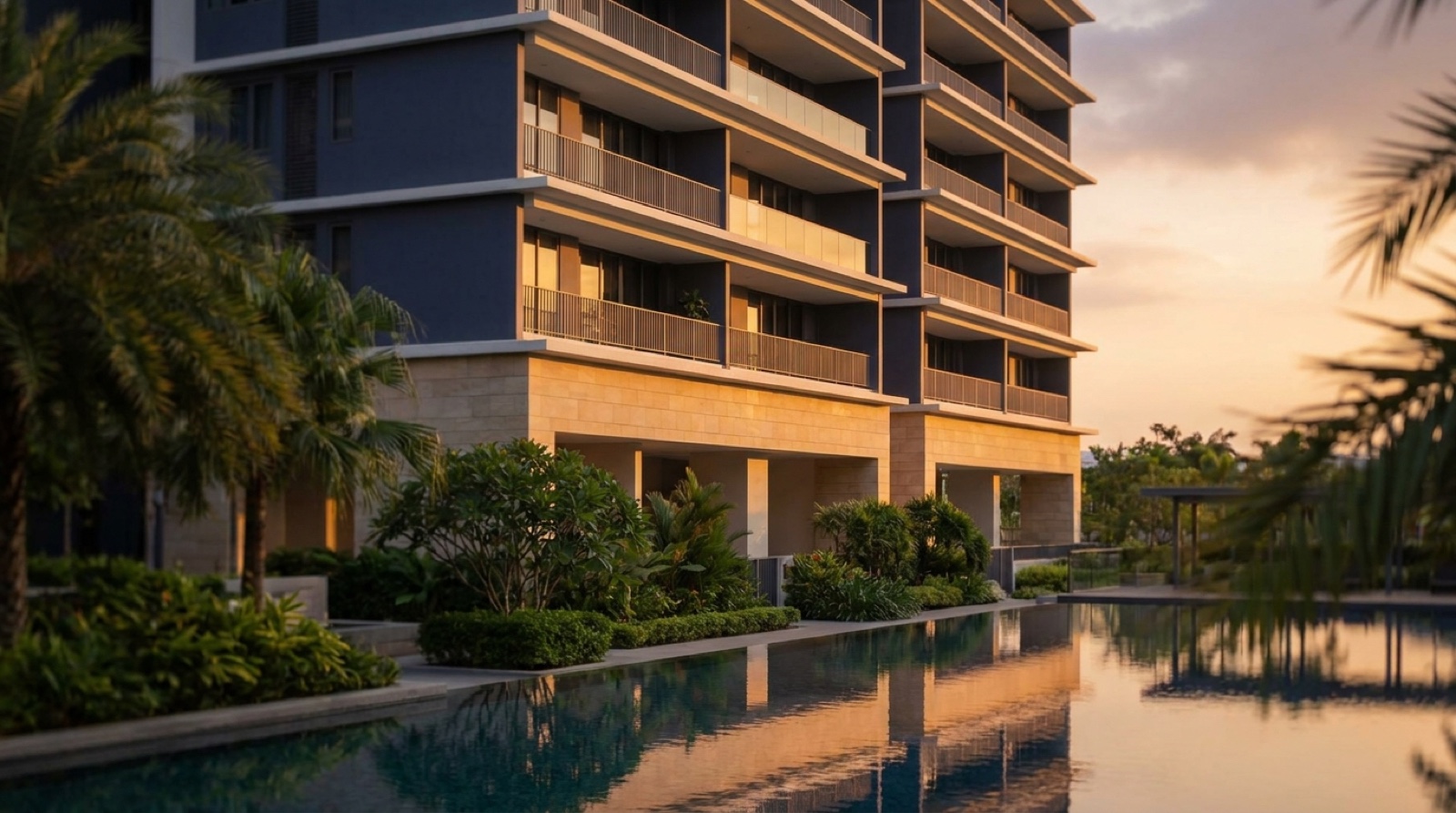
As a rough guide, you need to earn about S$9,800 a month to buy a S$1.5 million condo, around S$13,100 for a S$2 million one, and roughly S$16,300 for S$2.5 million — assuming a 75% loan, no other debt, a 30-year tenure and the bank’s 4% stress-test rate. That is the income that gets a loan approved. It is not the same as the money that gets the purchase done, and treating the two as identical is how buyers overcommit.
Income determines how much you can borrow. But the price you can actually transact at is shaped just as much by your CPF balances, existing equity, cash reserves, stamp duties, age, debt commitments and the loan tenure available. A bank approval is a ceiling. It should not become your target.
How much do you need to earn to buy a condo in Singapore?
The starting point is the Total Debt Servicing Ratio, or TDSR. For a private residential purchase, your total monthly debt obligations generally cannot exceed 55% of your gross monthly income. That includes the proposed mortgage plus car loans, education and personal loans, credit facilities, and any obligation where you are a borrower or guarantor.
Crucially, banks do not assess your loan at the low promotional rate you see advertised. They apply a stress-test rate — a regulatory floor of 4% for residential property, or the actual rate if higher — to check you could still service the loan if borrowing costs rose. That single distinction is why a repayment that feels comfortable today produces a smaller approved loan.
Assumes a 75% loan-to-value ratio, no other monthly debt, a 30-year loan, and assessment at 4%. Planning figures, not a bank quote.
| Condo price | Illustrative 75% loan | Est. monthly repayment | Min. gross monthly income |
|---|---|---|---|
| S$1.5 million | S$1.125m | ~S$5,370 | ~S$9,800 |
| S$2.0 million | S$1.500m | ~S$7,160 | ~S$13,100 |
| S$2.5 million | S$1.875m | ~S$8,950 | ~S$16,300 |
Income = assessed repayment ÷ 55% TDSR. Your figure moves with tenure, age and existing debt.
This is why a household earning S$15,000 a month may have the borrowing capacity for a S$2 million private home, while one earning S$10,000 may need to stay closer to S$1.5 million. But your available loan can be lower if you carry existing debt, are older, have uneven income, or need a shorter tenure. A 30-year loan is usually more favourable for monthly affordability than a 20- or 25-year one — though a tenure past 30 years, or age-plus-tenure beyond 65, lowers the loan-to-value limit. The financing has to be built around the buyer, not reverse-engineered around a listing.
The income number is not your buying budget
A condo requires capital before it requires monthly income. With a bank loan at 75% loan-to-value, you fund the remaining 25% of the price — at least 5% of it in cash, the balance in cash and eligible CPF Ordinary Account savings. Then Buyer’s Stamp Duty sits on top of the downpayment. For a first-property purchase, the cash-and-CPF you need at the start looks like this.
First-property Buyer’s Stamp Duty on a 75% loan. Excludes legal and valuation fees, and any renovation.
| Condo price | 25% downpayment | Buyer’s Stamp Duty | Capital before other costs |
|---|---|---|---|
| S$1.5 million | S$375,000 | S$44,600 | ~S$419,600 |
| S$2.0 million | S$500,000 | S$69,600 | ~S$569,600 |
| S$2.5 million | S$625,000 | S$94,600 | ~S$719,600 |
BSD is the same regardless of citizenship or property count — it is ABSD that varies.
This is why two buyers on the same income make very different decisions. One has substantial CPF balances and sale proceeds from an HDB flat or existing condo. The other has strong earnings but insufficient deployable capital. Income gets the loan approved; equity and liquidity get the transaction completed.
Additional Buyer’s Stamp Duty changes the equation sharply for a second or subsequent property, for permanent residents, and for foreign buyers — and those rates are policy-sensitive, so confirm them before exercising an option. In those cases the binding question is often not income at all. It is whether the extra tax changes the risk-adjusted return of owning another private home.
Existing debt changes the answer quickly
TDSR is measured against gross income, not take-home pay — a useful regulatory guardrail, but not a full picture of household comfort. And an existing commitment can move the answer by hundreds of thousands of dollars.
Take a household earning S$15,000 a month. At 55% TDSR, assessed debt cannot exceed S$8,250 a month. With no other debt, that supports a loan of about S$1.72 million. Add a S$1,500 car loan and only S$6,750 remains for the mortgage — which supports roughly S$1.41 million. One car loan, about S$310,000 less house. The same applies to investment-property loans, renovation financing and unsecured credit. Before you view anything, map every commitment and work out which will still be there after completion.
For the self-employed, business owners and those on commission-heavy pay, “usable income” is more nuanced. Lenders may average earnings across periods, haircut variable income, or ask for more documentation. A strong headline income helps, but consistency and paperwork often decide how much of it counts.
CPF is funding, not a reason to stretch
CPF can be a powerful part of a condo upgrade, especially for owners with years of Ordinary Account balances and housing equity. But it is not free capital. Whatever you use for housing is returned to your CPF, with accrued interest, when the property is sold — which quietly shrinks the cash proceeds available for your next move. A household that pours every CPF dollar into the entry can find, years later, that an appreciated home still leaves a constrained deposit once refunds, loan redemption and selling costs are settled.
So the sharper question is not whether you can use CPF. It is how much CPF use keeps the household resilient while preserving future options. Cash reserves matter most exactly when they are hardest to rebuild — through renovation, a gap between homes, a family change, or a stretch of higher rates.
Buy within a range that protects your next move
A disciplined budget usually sits below the maximum a lender will approve. That gap is what absorbs rate rises, maintenance, family expenses and the portfolio decisions you cannot foresee today. Start from your real position — sale proceeds, outstanding loan, CPF refund obligation, liquid cash, monthly debt — then model the purchase at a realistic stress rate, not the promotional one you hope to get.
Then test the exit. Ask who you are likely to sell to in five to ten years, what competing supply might exist, and whether the unit’s size, price quantum, tenure and location support durable demand. Affordability gets you into the market; it does not tell you whether the asset is any good. A buyer who can afford S$2 million has established a range, not made a decision — and within that range, entry price, incoming supply and transaction evidence produce very different outcomes.
That second question — not “can I afford it” but “of everything I can afford, which will hold its value” — is where our in-house analysis engine, BuySafe, comes in: a size- and floor-adjusted read of how projects have actually performed, built from 140,000+ publicly available URA transactions across 3,000+ projects. It is not a public login; we walk clients through it on their own shortlist. Know the exit before you enter.
Next: TDSR and MSR: how the borrowing limit is actually set →
Sources
The income figure is a ceiling, not a plan. We model your real capacity (income, CPF, cash and existing equity) then pressure-test which projects hold their value within it.
Keep reading
Related notes.
What checks should you do before buying a landed home in Singapore?
Four official plans show what can be built on your street, what runs under the garden and whether LTA has a claim on the frontage.
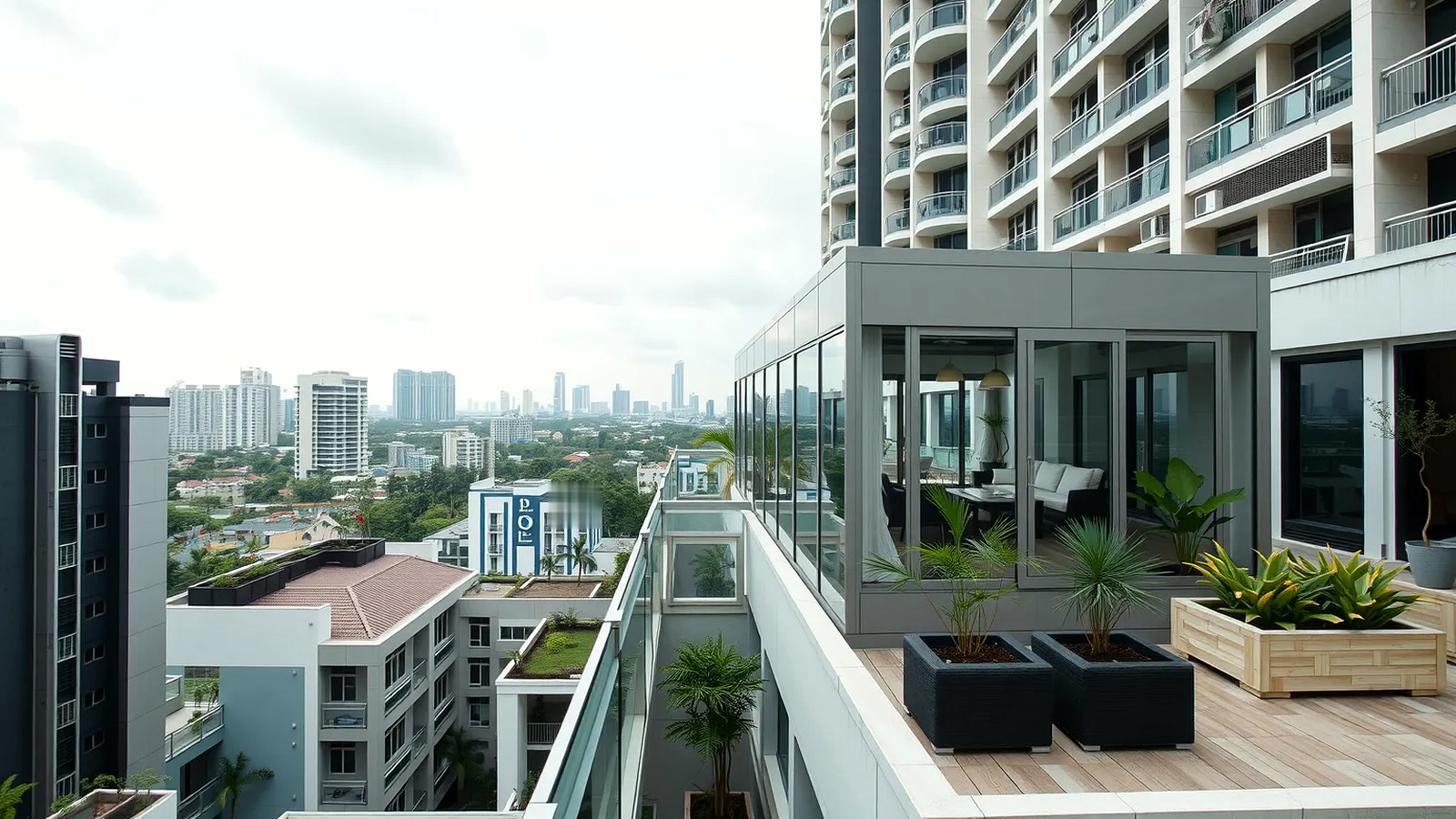
Unauthorised works in condos: the $200,000 problem you can inherit, and how to check before you buy.
URA says reports of unauthorised works in strata homes have run at about 150 a year since 2024, nine in ten are confirmed, and the owner on title is responsible for fixing them even if the loft or the enclosed roof terrace came with the unit. Fines reach $200,000 under two Acts. Here is what counts as unauthorised, what it costs, how a buyer checks a unit for $91.50 in searches, and what an owner does about works already in place.
Inherited a property in Singapore? Here is the process, the tax you don’t owe, and the one you quietly do.
What to do if you inherit a property in Singapore: no estate duty, no stamp duty on the inheritance itself and no CPF refund on the deceased’s savings, but HDB runs a 6-month and a 12-month clock after probate, a landed home cannot pass to a foreign heir without approval, and the property joins your ABSD count on whatever you buy next.
Not financial advice. This is general information about how income, TDSR and stamp duty interact when buying a condo in Singapore. It is not financial, investment, mortgage, tax or legal advice, and not a recommendation to borrow any amount or to buy, sell or hold property. Your actual limit depends on a lender’s assessment of your circumstances.
Figures are illustrative, and rates change. The income, loan, repayment, BSD and capital figures are worked examples on the stated assumptions (75% LTV, 4% stress rate, 30-year tenure, no other debt) and will differ for your situation. The 55% TDSR, 4% medium-term rate floor, 75% LTV cap and BSD tiers are set by MAS, HDB and IRAS and are current as at 2026 — they can change without notice. Confirm your exact position with a bank or mortgage adviser before committing.
Independent. The Property Collective is a team within PropNex Realty and is not affiliated with, endorsed by, or connected to any government agency. BuySafe analyses resale private condos using historical, publicly available URA transaction data and does not cover new launches; past performance is not indicative of future results.