How much is my condo worth? There is no single official answer, only a defensible range: three to five recent, genuinely comparable transactions in your own project, adjusted for floor and size, pulled free from URA’s own transaction database. Build that range properly and it will typically sit within about 5 to 10% of what an accredited bank valuer would say, at no cost. The gap between a hopeful asking price and a defensible one is exactly where deals stall, refinancing applications stumble, and sellers misread their own market.
Sources: URA Property Market Information e-service; MAS residential property loan rules.
How much is my condo worth right now?
Pull three to five comparable transactions from your project, adjust for floor and size: the range should land within about 5 to 10% of a bank valuer’s figure. “Comparable” does the heavy lifting here: it means the same stack where possible, otherwise a similar facing and floor band, sold within the last three to six months, at a similar size to your own unit. A transaction from a different stack facing the car park two years ago tells you very little about your high-floor, unblocked-view unit today.
URA’s Private Residential Property Transactions e-service gives you this raw material for free: a rolling 60-month window of every private residential caveat lodged, searchable by project, with price, floor band, size, and transacted date. Resale and subsale transactions update twice a week, on Tuesdays and Fridays. For history beyond five years, URA’s paid REALIS subscription covers transactions back to 1995, but for most owners checking a single unit, the free e-service is enough.
Three ways to check, and what each one actually measures
Owners typically reach for one of four methods, and they are not interchangeable. Each answers a slightly different question, and knowing which one you are actually asking saves you from comparing a rough estimate to a number that was never meant to match it.
Assembled from URA, MAS, EdgeProp and 99.co published information on each method.
| Method | Cost | Turnaround | Best used for |
|---|---|---|---|
| URA transactions (DIY) | Free | ~15 min | A first, defensible range before you talk to anyone |
| Portal AVM (EdgeProp, 99.co) | Free | Instant | A quick temperature check, not a number to negotiate on |
| Bank valuation | $300–700+ GST | 5–10 working days | The figure your loan and LTV are actually calculated against |
| Agent comp-read (size- and floor-adjusted) | Free, with an advisory conversation | 1–2 days | Deciding whether to list, at what price, and to whom |
None of these is “the” valuation. A bank valuation is the only one your lender is bound by.
How does a bank valuation actually work?
A panel valuer prices your unit from recent comparable transactions, physically or by desktop review, typically ready 5 to 10 working days after the Option to Purchase is signed.
The valuer weighs the most recent, most comparable transactions most heavily, then adjusts for floor, stack, facing and condition. The report generally costs $300 to $700 plus GST, sometimes absorbed into the bank’s loan package, and stays valid for around 3 to 6 months. Crucially, it is the figure your bank actually lends against, which is why it matters more than any free estimate the moment you are financing a purchase, a sale, or a refinance.
Why is my online estimate different from my bank valuation?
Portal tools price your unit algorithmically from recent-area transactions, and they can miss your specific floor, facing, renovation, or a thin pool of truly comparable deals.
99.co’s Property Value Tool, powered by SRX X-Value, describes itself as an automated valuation model drawing on historical and recent transactions from HDB, URA and agency data, adjusted for location, size, floor and age. EdgeProp’s Edge Fair Value similarly draws on recent comparable transactions, built on a methodology it says is endorsed by experienced valuers. Both are useful as a first temperature check, both are free, and both carry the same limitation: they cannot see your unit’s actual condition, and in a project with few recent transactions, the model has thin evidence to work with. Treat the number as a starting point, not something to defend in a negotiation.
A worked example: from three comps to one defensible number
Take a hypothetical 900 sqft, unrenovated unit on the 28th floor of a fictional 99-year leasehold project, used here purely to show the method rather than a real transaction.
Illustrative figures only, for method demonstration.
| Comp | Floor | Size | Sold | $psf |
|---|---|---|---|---|
| Comp 1 | #08 | 900 sqft | 3 months ago | $1,450 |
| Comp 2 | #15 | 850 sqft | 2 months ago | $1,510 |
| Comp 3 | #32 | 900 sqft | 1 month ago | $1,590 |
Comp 3 is the strongest match: same size, closest floor band, most recent.
A naive average of the three psf figures gives about $1,517 psf. That is the wrong answer, because it treats a three-month-old, lower-floor transaction as equal evidence to a one-month-old sale two floors from the subject unit. Comp 3 deserves the most weight on floor proximity and recency; Comp 2 sold smaller, and smaller units often carry a size premium per square foot that will not hold at 900 sqft; Comp 1 mainly shows the market’s direction over the quarter, not today’s price.
Why did my valuation come in lower than my asking price?
A valuation reflects transacted evidence, not hope: MAS caps your loan at 75% of the LOWER of price or valuation, so any gap above that is cash, not loan or CPF.
Say a buyer agrees to pay $1.5 million for a resale unit, and the bank’s panel valuer values it at $1.45 million. MAS caps the loan at 75% of whichever is lower, purchase price or valuation, so the maximum loan is $1,087,500, roughly $37,500 less than the buyer would have borrowed against the full price. The $50,000 gap between price and valuation cannot be covered by the loan or by CPF; it comes out of the buyer’s cash, on top of the normal downpayment. This is the private-market version of what HDB buyers know as cash-over-valuation, and it applies whenever a valuation lags a fast-moving asking price.
What we check before we tell a client to list
A defensible number protects both sides of a listing: it stops a seller from anchoring too high and sitting unsold while the listing itself becomes a stale-price signal, and it stops a buyer from committing to an Option to Purchase before knowing whether the bank will actually agree. That is the discipline behind the red flag we tell buyers to watch for: a price opinion with no comparables behind it is a recruitment pitch for your listing, not an assessment.
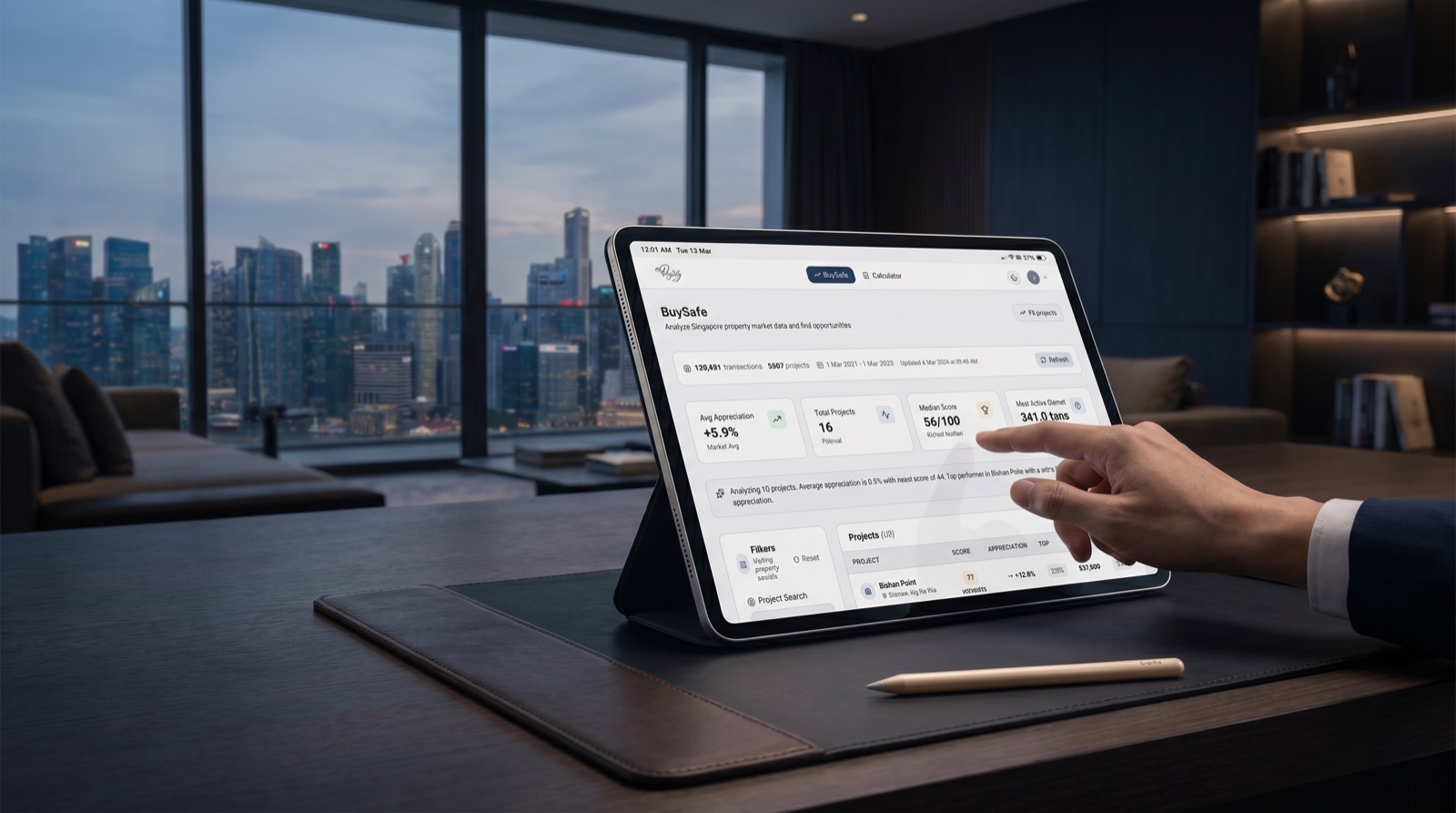
It is also why we read every unit through its exit before we talk about entry, or about a listing price. Our in-house engine, BuySafe, builds a size- and floor-adjusted view of how comparable units have actually performed, drawn from 140,000+ publicly available URA transactions across 3,000+ resale private condo projects. It does not score new launches, and it is not a public login; we walk clients through it on their own unit or shortlist. The same exit-first discipline that shapes a buying decision should shape the number you put on your own home.
Next: the exit strategy most owners never plan →
Sources
Thinking of selling, refinancing, or just want to know where you stand? We build the size- and floor-adjusted number your bank will actually respect, before you list.
Keep reading
Related notes.

Inherited a property in Singapore? Here is the process, the tax you don’t owe, and the one you quietly do.
What to do if you inherit a property in Singapore: no estate duty, no stamp duty on the inheritance itself and no CPF refund on the deceased’s savings, but HDB runs a 6-month and a 12-month clock after probate, a landed home cannot pass to a foreign heir without approval, and the property joins your ABSD count on whatever you buy next.
Divorce and your property in Singapore: what actually happens to the flat, the CPF, and the next purchase.
A divorce court order can move the matrimonial home to one spouse without any stamp duty. But the CPF refund is a default the Court can vary, a subsidised flat still carries a resale levy, and a replacement home bought before the old one is sold can trigger ABSD anyway. Here is how property, CPF and tax actually work through a Singapore divorce.
Mortgagee sales just hit a five-year high. Here is what actually happens if you can’t pay your mortgage.
What happens if you can’t pay your mortgage in Singapore: 216 mortgagee sale listings hit the market in 1H 2026, a five-year high. The real sequence is slower and more negotiable than the auction headlines suggest, for both HDB and bank loans, if you act while the loan is still current.
Not financial advice. This is general information about how condo valuations work in Singapore. It is not financial, investment, mortgage, legal or tax advice, and not a valuation of any specific property. Confirm your actual loan quantum and valuation with a bank before acting.
Worked example is illustrative. The three-comp worked example uses a hypothetical unit and hypothetical figures to demonstrate the method only. It is not drawn from a real project’s transaction history and should not be read as a valuation of any actual unit.
Independent. The Property Collective is a team within PropNex Realty and is not affiliated with, endorsed by, or connected to URA, MAS, EdgeProp or 99.co. BuySafe analyses resale private condos using historical, publicly available URA transaction data and does not score new launches or HDB flats; past performance is not indicative of future results.