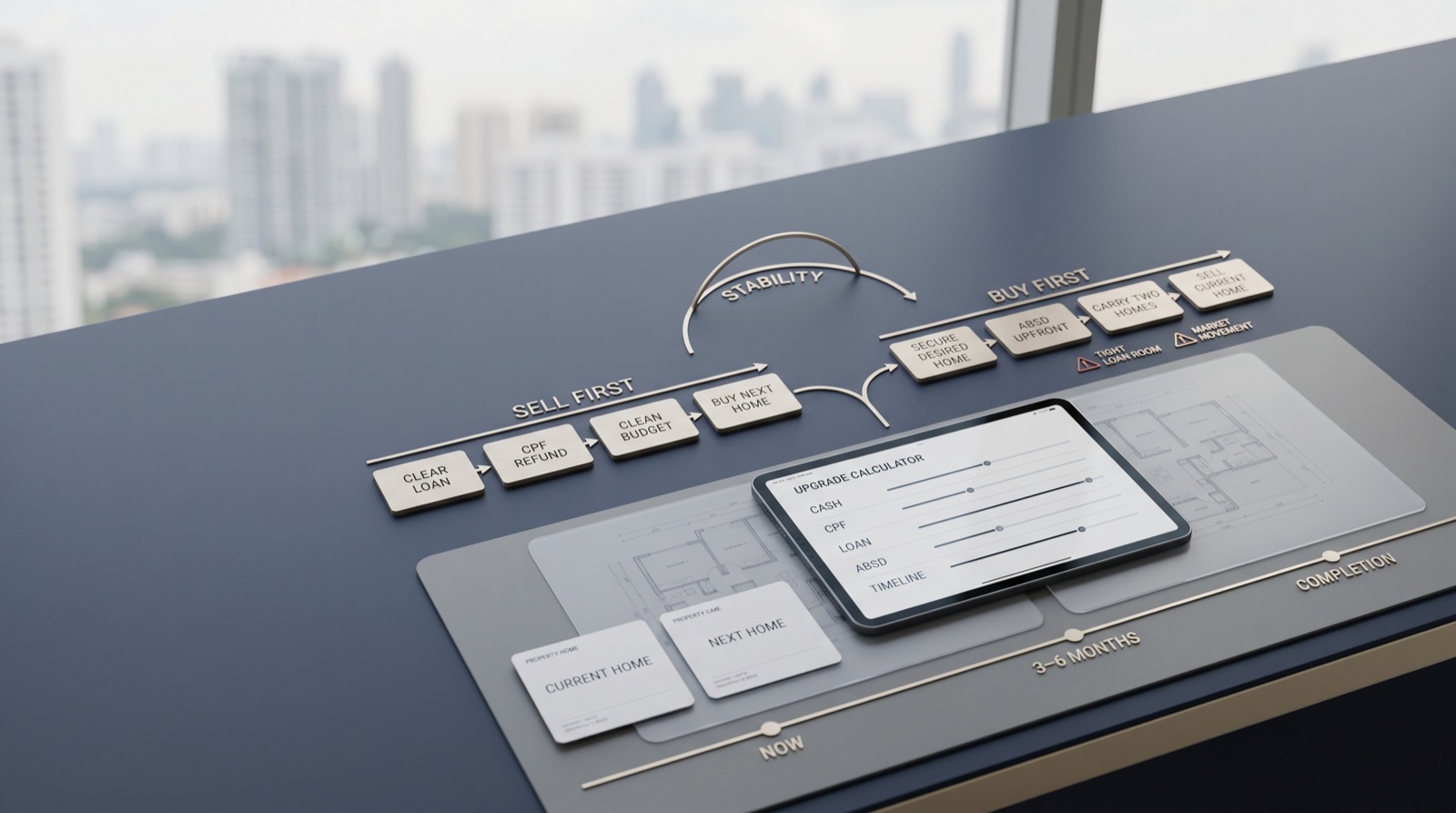
When you upgrade, the hardest question often isn’t which home to buy. It’s the order: do you sell your current place first, then buy — or buy the new one first, then sell? That single choice quietly decides how much cash you have, how much tax you pay, and how much room you have to negotiate.
The order changes everything for an upgrader. It affects how much cash you can put down, whether you get hit with Additional Buyer’s Stamp Duty (ABSD), how much the bank will lend you, and how exposed you are if the market moves while you’re mid-switch. Get it right and your money keeps working. Get it wrong and it gets stuck.
What actually decides it (and it isn’t confidence)
There’s no one-size answer. The right order depends on your numbers, not on how brave you feel.
If you need the money from selling your current home to fund the next one — to free up cash, cut your debt, or get the loan approved — selling first is usually the cleaner path. If you’ve got enough cash to buy the next place without strain, can handle owning two homes for a while, and have a realistic plan to sell the first, buying first can give you more control over what you get and when.
Many owners answer this with their gut. Some fear selling too early and ending up with nowhere to live. Others fear buying too early and being stuck with two homes. Both fears make sense. Neither is a plan.
The better way is to get five things clear, in order — then the answer usually picks itself:
- Cash on hand. What you can actually put down today, without dipping into reserves you’ll need.
- Your CPF. How much you can use, and what gets refunded back to it when you sell.
- Your outstanding loan. How much is left to clear on the current home before the proceeds are really yours.
- Stamp duty. Whether the order you choose triggers ABSD upfront.
- Your timeline. How quickly you need — or can afford to wait — to find the next home.
Sell first vs buy first, at a glance
Two routes, two trade-offs
Best when you need the sale money to fund the next home. You know your exact cash, your loan is cleared, and you usually avoid ABSD. The catch: you may rent in between, and you miss out if prices climb while you’re still looking.
Best when you have strong cash and don’t need the sale proceeds yet. You grab the right home the moment it appears. The catch: you may pay 20% ABSD upfront, carry two loans for a while, and your next loan can shrink while you still owe on the first.
When selling first is the stronger move
Selling first suits owners whose next purchase leans heavily on the money tied up in the current home. That’s common for HDB owners moving into a condo, and for condo owners stretching to a bigger unit or a better area.
The big win is certainty. You know exactly what you banked, how much CPF you have, and what the bank will really lend once the first home is off your books. Far less guesswork — and far less chance of overcommitting on the hope that your sale price and timing work out.
It also helps you sidestep ABSD if you don’t plan to hold two homes. Sell the first before you buy the next, and the deal is cleaner — which can save you a serious amount of cash.
There’s a quieter benefit too: once you know your real budget, you shop with discipline. You’re less likely to fall for a glossy launch that looks great on paper but squeezes you when the loan figures land.
The trade-off is obvious. You might need to rent for a bit, arrange an extension to stay on, or run a tight timeline — and the market could rise while you’re between homes. Selling first protects your downside, but it can leave you with fewer choices on the buy side if good options dry up.
For many families, though, protecting the downside matters more than keeping every option open. An upgrade should improve your position — not test your nerves.
When buying first makes sense
Buying first works best when you have strong cash and don’t need the sale money to complete the next purchase.
That fits higher-income families, owners with healthy savings, or those whose current home should sell well but who want time to land a very specific place. In a tight market, buying first is the aggressive move — you secure the right home when it shows up, instead of settling later under pressure.
That matters more than people think. When upgrading, buying the wrong home usually costs you far more than the discomfort of briefly owning two. A so-so place bought against the clock can underperform for years.
Still, buying first takes discipline. You need a clear plan for the ABSD, enough staying power if the sale drags, and honest confidence that your current home will sell at a realistic price — not a hopeful one.
There’s also the loan side. Banks look at what you still owe at the point you apply. Buy first while you’re still carrying the current mortgage, and your numbers look tighter, so the loan they offer can shrink. That can quietly narrow the homes within your reach.
In short: buying first can get you a better home — but only if your finances can absorb owning two for a while.
Four risks most owners underestimate
- Banking on a sale price you haven’t got yet. The market doesn’t care what you paid or hoped for. It pays for the right price, the right unit and the right timing — plan on a realistic number, not a wishful one.
- Forgetting the in-between costs. Stamp duties, legal fees, the CPF you refund, renovation overlap, renting in between — they all eat into your usable cash. They are not small print; they can make or break the deal.
- Assuming the loan is locked in. It isn’t. A change in your income papers, your age, interest rates, or your existing debts can move what a bank will lend.
- Looking only at buying, not at selling next time. A bigger home isn’t automatically a better one. Some upgrades have thinner resale demand and are harder to sell later. More expensive doesn’t always mean smarter.
A simple way to decide your order
Start with one question: if your current home didn’t sell for three to six months, could you still complete the next purchase without strain?
If no — selling first is probably the sensible route.
If yes, ask the next one: is the home you want rare enough that waiting might force you into a weaker option later?
If no — there’s little reason to take on the stress of owning two. Sell first, keep your options open, and buy with clean numbers.
If yes — buying first may be worth it, but only after you’ve worked out the exact figures: how much cash you need upfront, what duties you’ll pay, what loan you can get while the old mortgage is still running, and how long you could comfortably carry both.
This is where good advice pays off. The decision is rarely about the order alone — it’s about whether the next home actually improves your position over the next five to ten years. A solid plan runs at least three what-ifs: your home sells as expected, it sells slower than hoped, and it sells for less than you wanted. If the upgrade only works in the best case, it’s not ready yet.
HDB owners and condo owners shouldn’t decide the same way
For HDB owners moving to private, selling first is usually more efficient, because the sale money and CPF are central to funding the next home. The margin for error is thinner, and you need the full picture clear before you commit.
For condo owners, it’s more open. If you’ve got plenty of equity, low debt, and enough cash to bridge the gap, buying first can make sense — especially when you’re chasing a specific project, layout or school zone where good units are scarce.
But even then, let the home’s quality lead — not urgency, not ego, and not the idea that every step up is automatically a win. A bigger unit in a weaker development might feel nicer but drag on your returns. A smaller, better-placed home can give you a stronger mix of comfort, easy resale and a clean future exit.
Timing your own readiness beats timing the market
Plenty of owners wait for the “perfect” market moment. That usually just creates delay, not an edge.
The better question is whether you’re ready. Are your sale proceeds clear? Have you tested your financing? Have you chosen the type of home with evidence, not just feel? Have you mapped out what happens at different sale prices, or if interest rates stay high longer than expected?
Market cycles matter, of course. But these decisions are won far more by preparation than by prediction. Owners who know their numbers move calmly and give away less at the table.
That’s the real value of getting sell-first vs buy-first right. It’s not just doing two deals in the right order — it’s keeping your options open, avoiding forced decisions, and putting your money into the next home on purpose.
At The Property Collective, this planning usually starts not with property listings, but with the numbers — and with the home itself. Before you choose the next address, our in-house tool, BuySafe, checks whether it has genuinely held its value: real, like-for-like price growth (with size and floor stripped out) across 140,000+ publicly available URA transactions and 3,000+ private condo projects. Because the home you move into should earn its place in your plan, not just look the part.
The right upgrade feels less like a leap and more like a calm, deliberate move. That’s usually the sign you’ve got the order right.
The full upgrader money playbook →
Sell-first or buy-first isn’t a gut call, it’s a numbers call. We run the scenarios with you before you commit to either.
Keep reading
Related notes.
More flats are coming. What the 2026 to 2028 supply wave does to HDB resale prices.
HDB resale prices have fallen two quarters in a row, and the flats reaching their five-year MOP rise from about 13,500 this year to 19,500 in 2028. History says supply caps the upside but demand sets the direction. Here is where the softness lands first, and what it means if you are selling to upgrade.
Downgrading from a condo to HDB: what it actually unlocks, and what it costs.
Downgrading from a condo to HDB in Singapore no longer means a 15-month wait, and for most Singapore Citizens it now comes with zero ABSD. What eligibility actually requires, the CPF refund maths, and a worked example of what the move genuinely frees up.

Six quarters of muted growth: is this the upgrader’s window, or a trap?
Private prices have grown at 1% or less for six straight quarters, and HDB resale has now fallen two quarters in a row. That combination is unusual, and it changes the arithmetic of upgrading in a way most sellers have not noticed yet.
Not financial or tax advice. This is general commentary for informational purposes only. It is not financial, investment, tax, mortgage or legal advice, and not a recommendation to buy, sell or hold any property. Your position depends on your own circumstances.
Rules change. ABSD, TDSR, loan-to-value limits and CPF rules are set by IRAS, MAS, HDB and the CPF Board and can change without notice. Figures here are general guidance as at 2026 — confirm your exact position with IRAS, your banker or mortgage adviser, and a conveyancing lawyer before committing.
Independent. The Property Collective is not affiliated with, endorsed by, or connected to IRAS, MAS, HDB, the CPF Board, the URA, or any government agency. BuySafe analysis uses historical, publicly available URA transaction data.