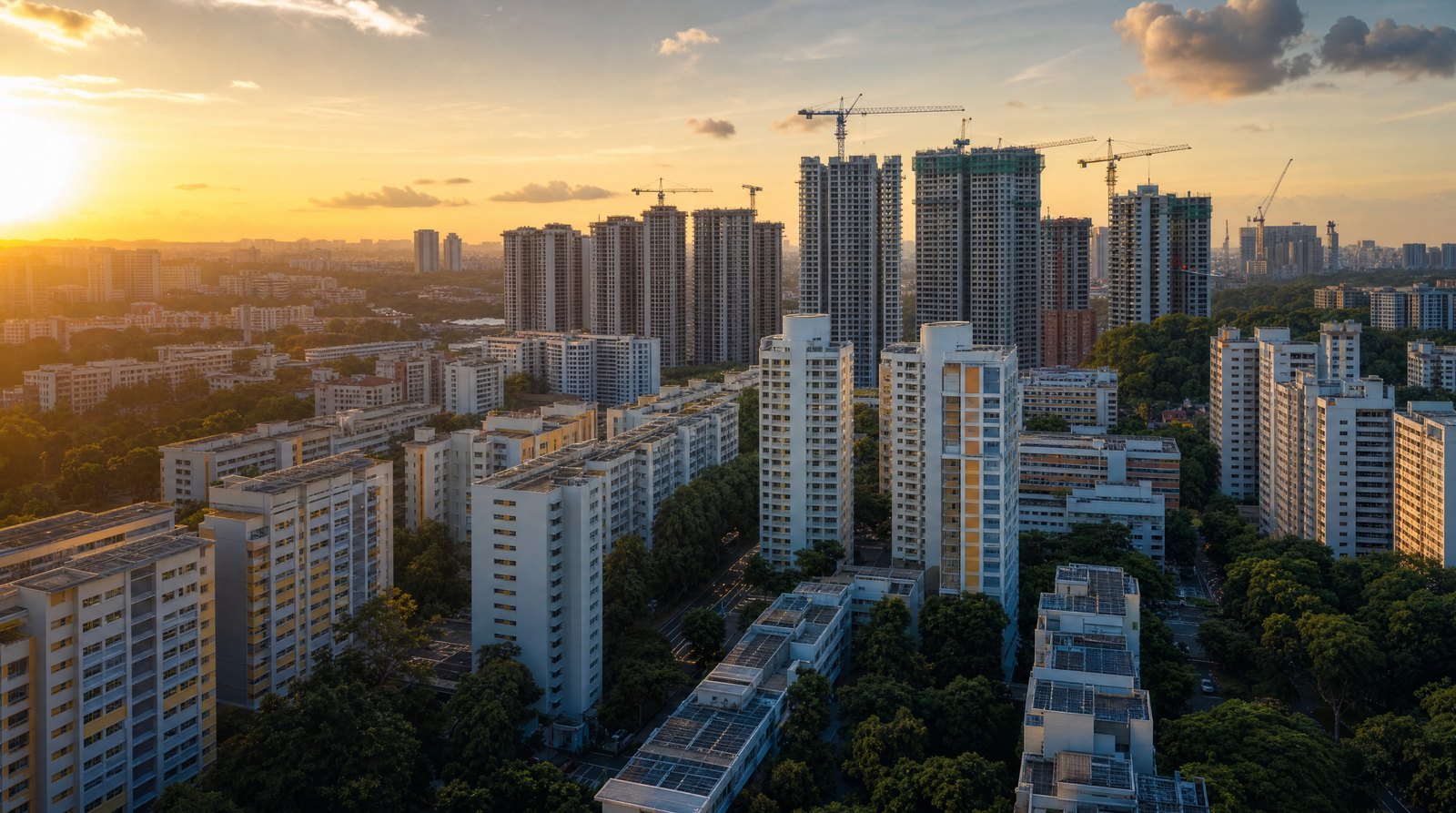
Downgrading from a condo to an HDB resale flat in Singapore is easier to time than at any point since 2022. The 15-month wait between selling a private home and buying a resale flat was removed on 28 July 2026, and Singapore Citizens who buy a resale flat while they still own their condo pay zero Additional Buyer’s Stamp Duty upfront, as long as the condo is sold within six months. What is left to work out is not whether the move is allowed. It is what the move actually does to your cash, your CPF and your retirement runway, which is where most downgraders lose the thread.
Sources: MND, IRAS and CPF Board, current as at August 2026.
Can you buy an HDB resale flat if you still own a condo?
Yes: Singapore Citizens and Permanent Residents can buy an HDB resale flat while they still own private property, provided they sell it within six months of completing the flat purchase.
Beyond that, the eligibility rules are the same as any resale purchase: you need a valid family nucleus, or you must be a Singapore Citizen aged 35 or older buying under the Single Singapore Citizen Scheme. If your household is two Permanent Residents with no citizen, each of you needs at least three years of PR status. There is no income ceiling to buy a resale flat outright; the ceiling only limits which CPF Housing Grants you can receive, and most downgraders selling a condo will not qualify for those grants anyway.
Do you pay ABSD when downgrading from a condo to HDB?
In most cases, no: IRAS remits a Singapore Citizen’s ABSD from 20% down to 0% on an HDB resale flat bought while they still own a condo, provided that condo sells within six months.
Permanent Residents get the same upfront treatment at a reduced rate: 5% instead of the standard 30% for a second property. It is worth naming the mechanism precisely, because it differs from how ABSD remission usually works. A couple replacing one private home with another pays the ABSD in full and reclaims it later. Here, IRAS does not collect it in the first place, on the strength of your undertaking to sell. Miss the six-month window and HDB and IRAS claw back the remitted amount, with interest, so the sale needs to be realistic, not aspirational, before you commit to the flat.
Additional Buyer’s Stamp Duty rates in force from 27 Apr 2023, and the upfront remission for private owners downgrading to a non-subsidised HDB resale flat. Source: IRAS.
| Buyer | Standard 2nd-property ABSD | Downgrade-to-HDB ABSD (remitted) |
|---|---|---|
| Singapore Citizen | 20% | 0%, if the condo sells within 6 months |
| Permanent Resident | 30% | 5%, if the condo sells within 6 months |
The remission is granted upfront, not reclaimed after payment. Miss the six-month sale and the remitted amount is clawed back with interest.
One more misconception worth clearing up: a resale levy does not apply here either. The levy only bites when you buy a new subsidised flat, a Design, Build and Sell Scheme unit, or an EC from a developer, after having received a housing subsidy before. Buying an HDB resale flat on the open market, whatever your subsidised-flat history, carries no resale levy at all.
Should you sell the condo first, or buy the HDB flat first?
Selling first is now the simpler route for most downgraders, since the wait-out period dropped from 15 months to zero on 28 July 2026, so you can buy the moment your condo completes.
Buying first still has a place: it lets you secure a specific flat before it is gone, and the ABSD remission means you are not fronting a six-figure stamp duty bill while you wait. But it puts you on a six-month clock to sell the condo, and if the sale slips, the clawback lands on a property you no longer wanted to hold. We generally point clients who do not need a specific flat urgently toward selling first: it fixes your exact budget before you shop, and the wait that used to make that painful is gone.
What happens to your CPF when you sell the condo?
Before any sale proceeds reach your bank account, you must refund your CPF Ordinary Account for whatever principal you used, plus 2.5% accrued interest, compounded for the whole time you held the condo.
That refund is not lost. It returns to your CPF, where it is available again, up to the valuation limit, to fund the HDB flat. But it is not cash in hand at the point of sale, and on a condo held for over a decade the accrued interest alone can run into six figures. We set out the mechanics and a worked example in detail here; the short version is that the longer you have held the condo and the more CPF you used, the larger the share of your equity that comes back as CPF rather than cash.
How much cash does downgrading from a condo to HDB actually free up?
In a representative case, a downgrader with a mostly paid-down condo can free roughly $536,000 in cash, debt-free, plus $290,000 restored to CPF, after buying a five-room resale flat outright. Your own number depends entirely on your loan balance, your CPF history and the flat you choose.
A hypothetical, round-number example to show the mechanics, not a specific transaction. Figures assume a Singapore Citizen selling a condo held 15 years with $200,000 of original CPF used.
| Line item | Amount |
|---|---|
| Condo sale price | $1,800,000 |
| Less: agent commission (approx. 2% + GST) | −$39,240 |
| Less: outstanding mortgage | −$300,000 |
| Less: CPF refund (principal + 2.5% accrued interest, 15 yrs) | −$290,000 |
| = Net proceeds (cash + CPF combined) | $1,170,760 |
| New 5-room resale flat (mature estate, illustrative) | $900,000 |
| Less: CPF redeployed into the flat | −$290,000 |
| Plus: Buyer’s Stamp Duty on the flat | +$21,600 |
| Plus: legal and other costs (indicative) | +$3,000 |
| = Cash needed to complete, mortgage-free | $634,600 |
| Net cash freed up | ≈ $536,000 |
No ABSD in this example: the citizen sells the condo before completing the flat purchase, so ABSD never applies.
Read the table right and it says something specific: none of that $536,000 is investment return. It is equity you already owned, unlocked from one asset and moved into cash and a smaller one. The CPF portion is not free either; it went back to your retirement account, not your pocket. What the downgrade genuinely buys you is optionality: cash today, a lower monthly cost of living, and a flat that needs no mortgage, in exchange for the condo’s future appreciation and, for most families, a one-way door, since ABSD makes moving back to private expensive again.
Is downgrading from a condo to HDB actually worth it?
It is worth it when the cash and CPF you free up do more for you now, funding retirement, clearing debt, or backing a child’s home, than the condo’s likely future appreciation would, and that is a question about your specific unit, not a general rule.
Next: the exit strategy most owners never plan →
Sources
- MND: Removal of the 15-month Wait-out Period for Private Residential Property Owners Purchasing Non-Subsidised HDB Resale Flats (28 Jul 2026)
- CNA: 15-month wait-out period for private property owners to buy HDB flats removed: Chee Hong Tat (28 Jul 2026)
- IRAS: Additional Buyer's Stamp Duty (ABSD)
- Ask.gov.sg (IRAS): Do I pay ABSD if I downgrade from a private property to an HDB resale flat?
- IRAS: Buyer's Stamp Duty (BSD)
- HDB: Resale Levy Ensures Fair Subsidy Allocation
- CPF Board: Earning attractive interest (Ordinary Account rate)
Thinking about downgrading from your condo to an HDB flat? We model the CPF refund, the ABSD position and the exact cash freed on your own numbers, not a hypothetical, before you list.
Keep reading
Related notes.
More flats are coming. What the 2026 to 2028 supply wave does to HDB resale prices.
HDB resale prices have fallen two quarters in a row, and the flats reaching their five-year MOP rise from about 13,500 this year to 19,500 in 2028. History says supply caps the upside but demand sets the direction. Here is where the softness lands first, and what it means if you are selling to upgrade.
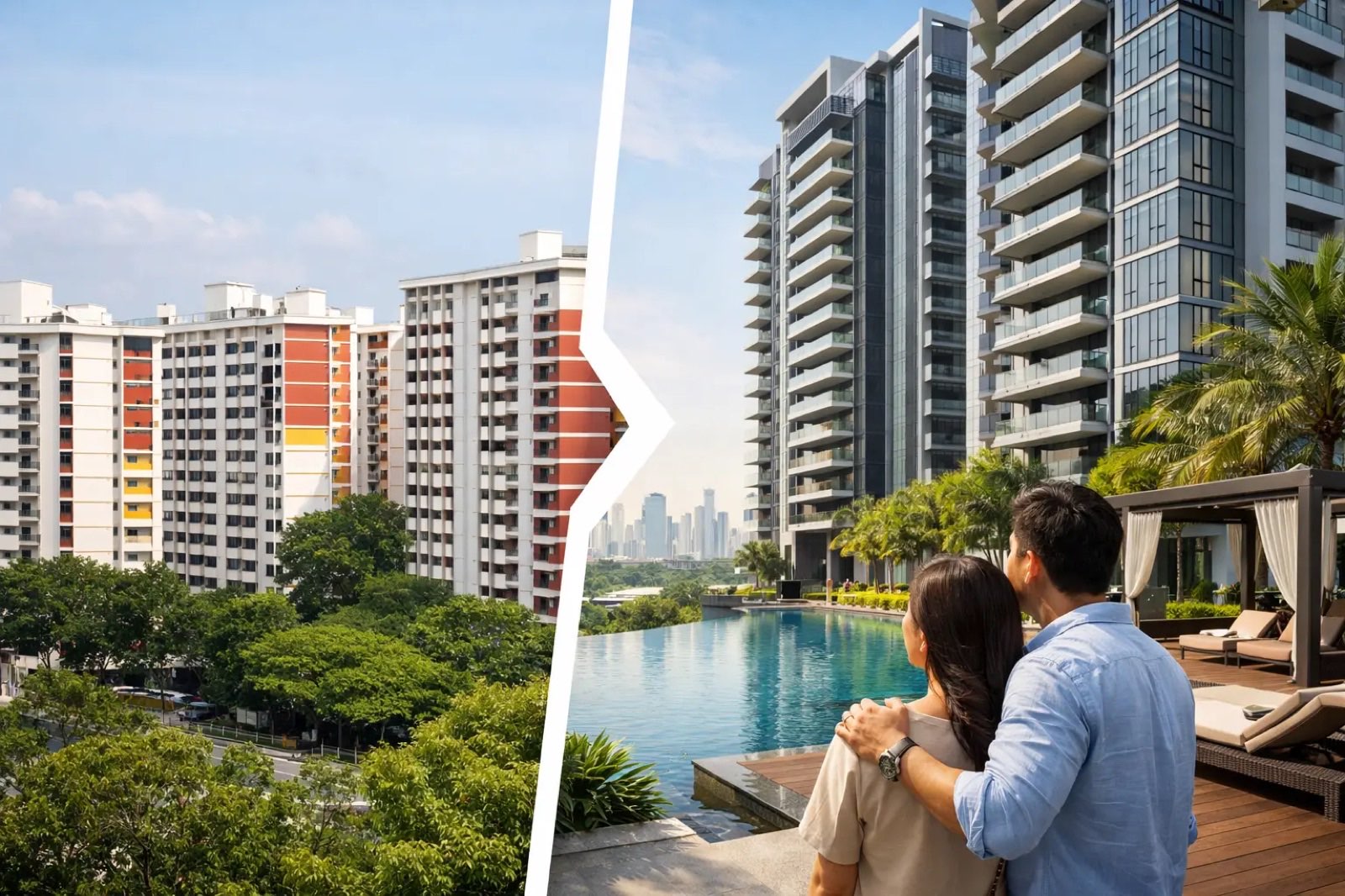
Six quarters of muted growth: is this the upgrader’s window, or a trap?
Private prices have grown at 1% or less for six straight quarters, and HDB resale has now fallen two quarters in a row. That combination is unusual, and it changes the arithmetic of upgrading in a way most sellers have not noticed yet.
Interest rates and your next upgrade: it’s the sensitivity, not the rate.
A half-percent move can redraw an upgrade, through loan quantum, holding power and timing, not just the monthly payment. When rates should change your move, and when they shouldn’t.
Figures are indicative. The worked example uses round, hypothetical numbers (an $1.8m condo, a $900,000 flat, 15 years of CPF accrued interest) to show the mechanics, not a specific transaction. ABSD, BSD, resale levy and CPF rules are set by IRAS, HDB and the CPF Board and can change; confirm your own figures with them before committing to a sale or purchase.
Not financial advice. This is general information and market commentary, not financial, investment, legal, tax or CPF advice, and not a recommendation to buy, sell or hold any property. Your own eligibility, tax position and CPF entitlement depend on your specific circumstances.
Independent. The Property Collective is a team within PropNex Realty and is not affiliated with, endorsed by, or connected to IRAS, HDB, the CPF Board, MND or any government agency. BuySafe analyses resale private condos using historical, publicly available URA transaction data; it does not cover HDB flats or new launches, and past performance is not indicative of future results.