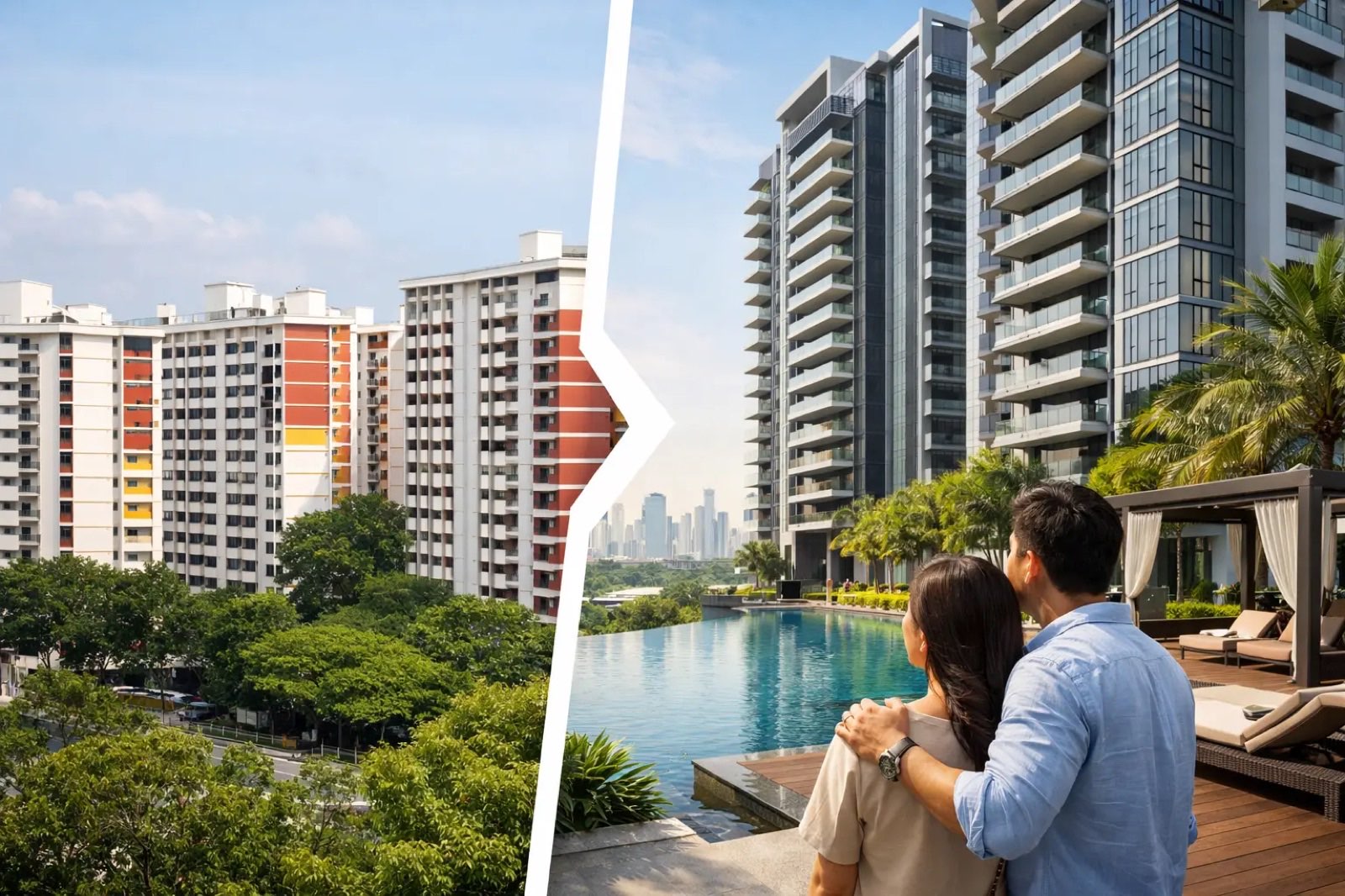
Ask most people when to upgrade and the instinct is the same: wait for prices to fall. But an upgrade is not one transaction, it is two, and the two move together. When prices race, your flat is worth more and the condo you want has run further ahead of it. When prices stall, your flat gains less and the gap you have to bridge stops widening. Right now Singapore is in the second state, on both sides of the trade at once, and it has been for longer than most buyers realise.
Sources: URA and HDB quarterly statistics, 1H 2026.
How much has Singapore property price growth slowed?
By roughly four fifths in three years. The private residential price index has now posted six consecutive quarters of growth at or below 1% quarter on quarter. Annually, the deceleration is stark: 6.8% in 2023, 3.9% in 2024, 3.3% in 2025 and 1.4% in the first half of 2026. This is not a crash and nobody should describe it as one. It is a market that has stopped sprinting.
Private residential property price index, annual change. 2026 figure is 1H only. Source: URA.
Four years, one direction of travel: the pace of price growth has fallen by roughly four fifths.
On the public housing side the move is sharper still. HDB resale prices fell 0.4% across the first half of 2026, with declines in both Q1 and Q2, after five quarters of progressively slower growth. The policy backdrop explains much of it: the ramp-up in Build-To-Order supply, roughly 55,000 flats launched between 2021 and 2025, and a large wave of flats reaching their Minimum Occupation Period and becoming sellable.
Why do slow markets favour upgraders?
Because the gap you have to bridge stops widening. An upgrader is short one asset and long another. You sell a flat and buy a condo, so what matters is not either price on its own but the gap between them. In a fast market that gap widens, because a 5% move on a $1.6 million condo is far larger in dollars than a 5% move on an $650,000 flat. The flat that gained $32,500 is chasing a target that moved $80,000. Every fast quarter costs the upgrader ground, even though their own asset went up.
Simplified illustration on a $650,000 flat and a $1.6 million condo, before costs, stamp duties and financing. For explanation, not a forecast.
| Scenario | Flat | Condo | Gap to bridge |
|---|---|---|---|
| Today | $650,000 | $1,600,000 | $950,000 |
| Both rise 5% | $682,500 | $1,680,000 | $997,500 |
| Both flat | $650,000 | $1,600,000 | $950,000 |
| Both fall 5% | $617,500 | $1,520,000 | $902,500 |
The upgrader is helped by slow or falling markets and hurt by fast ones, which is the opposite of the instinct most sellers bring to the table.
This is the honest core of the case. Moderating growth on both sides is structurally friendly to the upgrader, because it stops the target running away. Add the rate move, with 3-month SORA down from about 2.95% in January 2025 to around 1.1% by mid-2026, and the monthly cost of carrying the larger asset has fallen at the same time as the gap stopped widening.
What are the risks of upgrading now?
Two, and the first is your own flat. A soft HDB market cuts both ways, and any adviser who skips this is selling rather than advising. Your flat is the war chest for the upgrade. If HDB resale keeps easing while private prices hold or firm, the gap starts widening again from the other direction, and your deposit shrinks in real terms. Two quarters of decline is a moderation, not a trend, but it is a risk to plan around rather than ignore.
The second caution is that the private market is no longer one market. In Q2 2026 landed homes rose 2.5% and the prime core firmed while the city fringe fell 1.2% and the suburbs slipped. A market average of 0.5% tells you almost nothing about the specific project you are buying. That is a case for choosing the asset carefully, not for waiting for a national average to give permission.
So is this actually a window to upgrade?
For the right household, yes, on three conditions, and we would not sign off on an upgrade without all three.
And it is closed, for now, if your holding power is thin, if you would be stretching to the edge of affordability, or if you have not sequenced the sale and the purchase properly. We cover that sequencing in detail in sell first or buy first, because getting the order wrong is the most expensive mistake in this trade.
Next: the HDB to condo upgrade strategy that holds up →
Sources
Upgrading is two transactions, not one, and the gap between them is where the money is made or lost. We map your sell-and-buy sequence against your real numbers before you commit to either side.
Keep reading
Related notes.
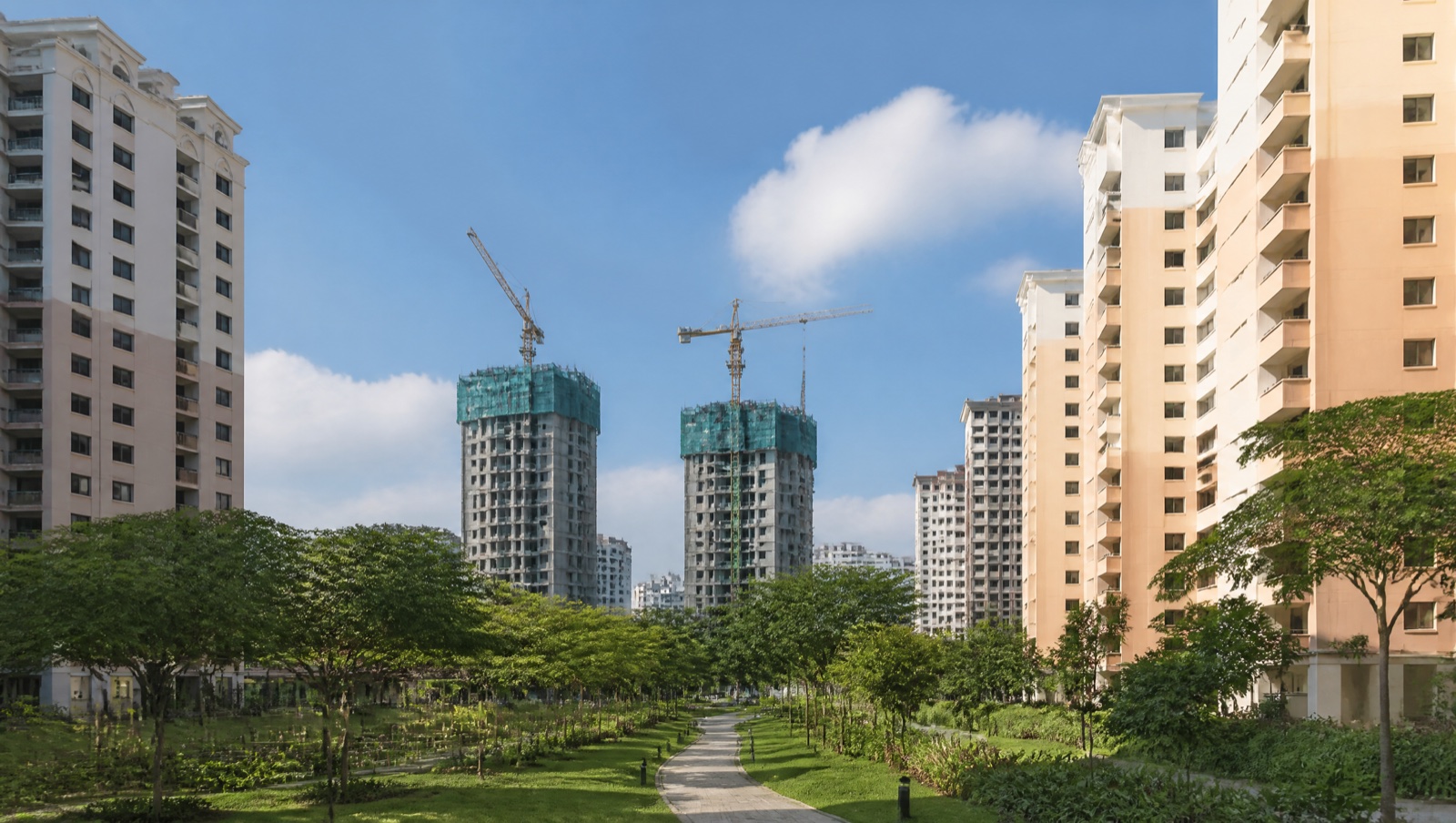
More flats are coming. What the 2026 to 2028 supply wave does to HDB resale prices.
HDB resale prices have fallen two quarters in a row, and the flats reaching their five-year MOP rise from about 13,500 this year to 19,500 in 2028. History says supply caps the upside but demand sets the direction. Here is where the softness lands first, and what it means if you are selling to upgrade.
Downgrading from a condo to HDB: what it actually unlocks, and what it costs.
Downgrading from a condo to HDB in Singapore no longer means a 15-month wait, and for most Singapore Citizens it now comes with zero ABSD. What eligibility actually requires, the CPF refund maths, and a worked example of what the move genuinely frees up.
Interest rates and your next upgrade: it’s the sensitivity, not the rate.
A half-percent move can redraw an upgrade, through loan quantum, holding power and timing, not just the monthly payment. When rates should change your move, and when they shouldn’t.
Not financial advice. This is general commentary for informational purposes only. It is not financial, investment, mortgage, legal or tax advice, and not a recommendation to buy, sell or hold any property. Your eligibility, borrowing limit and the right sequence for your move depend on your own circumstances and a lender’s assessment.
The illustration is an illustration. The flat-and-condo gap table uses round numbers to explain a mechanism. It excludes stamp duties, agent and legal fees, CPF accrued interest, financing costs and any Additional Buyer’s Stamp Duty timing effects, all of which materially change a real upgrade. Price index figures are from URA and HDB as at Q2 2026. Past performance is not indicative of future results.
Independent. The Property Collective is a team within PropNex Realty and is not affiliated with, endorsed by, or connected to URA, HDB or any developer.