HDB resale prices have now fallen two quarters in a row, the first back-to-back decline since 2019, and the supply behind that is only beginning. About 13,500 flats reach the end of their five-year Minimum Occupation Period in 2026, rising to 15,000 in 2027 and 19,500 in 2028, while HDB launches around 24,000 new flats this year. Our read: more supply keeps the index flat to slightly lower, it does not crash prices, and it splits the market. The towns with the most new resale stock feel it first, while scarce central flats keep setting records.
Sources: HDB flash estimates (30 Jun and 1 Oct 2026); The Straits Times (28 May 2025, 23 Aug 2026); EdgeProp (24 Jul 2026).
How much more HDB supply is actually coming?
Two pipes feed the resale market: flats that clear their five-year MOP and can be sold for the first time, and the new BTO and Sale of Balance flats that pull first-timers away from resale. Both are opening at once. Speaking in May 2025, National Development Minister Chee Hong Tat put the MOP cohort at about 13,500 flats in 2026, up from 8,000 in 2025, rising to 19,500 in 2028, and said resale prices "are expected to moderate in the years ahead" as a result. The Straits Times has since reported the 2027 figure at about 15,000. On the new-flat side, HDB is launching about 19,600 BTO flats in 2026, around 24,000 once Sale of Balance Flats are counted, and is on track to beat its 55,000-flat target for 2025 to 2027.
Sources: The Business Times (Oct 2022 for the 2009 to 2018 and 2019 to 2022 averages; 2019 and 2022 counts); The Straits Times (May 2025, Aug 2026). 2027 and 2028 are projections. Price changes from the HDB Resale Price Index.
| Year | Flats reaching MOP | What prices did |
|---|---|---|
| 2009 to 2018, average | about 7,800 a year | Peaked in 2013, then fell 12% to 2019 |
| 2019 | 29,678 | Bottomed in Q2 2019 |
| 2019 to 2022, average | about 26,400 a year | Rose 30% from mid-2020 to end-2022 |
| 2022 | 30,920 | Growth slowed to 10% for the year |
| 2025 | about 8,000 | Growth slowed to 2.9% |
| 2026 | about 13,500 | Down 0.4% in the first half |
| 2027, projected | about 15,000 | |
| 2028, projected | about 19,500 |
Sources: The Straits Times (28 May 2025, 23 Aug 2026). 2027 and 2028 are projections.
Even 2028 sits below the 26,400-a-year average of 2019 to 2022, the years in which prices rose fastest.
What happened to HDB prices the last two times supply surged?
Both times, the index went where demand pushed it, not where supply alone would have predicted. The chart marks the two episodes on the official Resale Price Index, and the wave that is starting now.
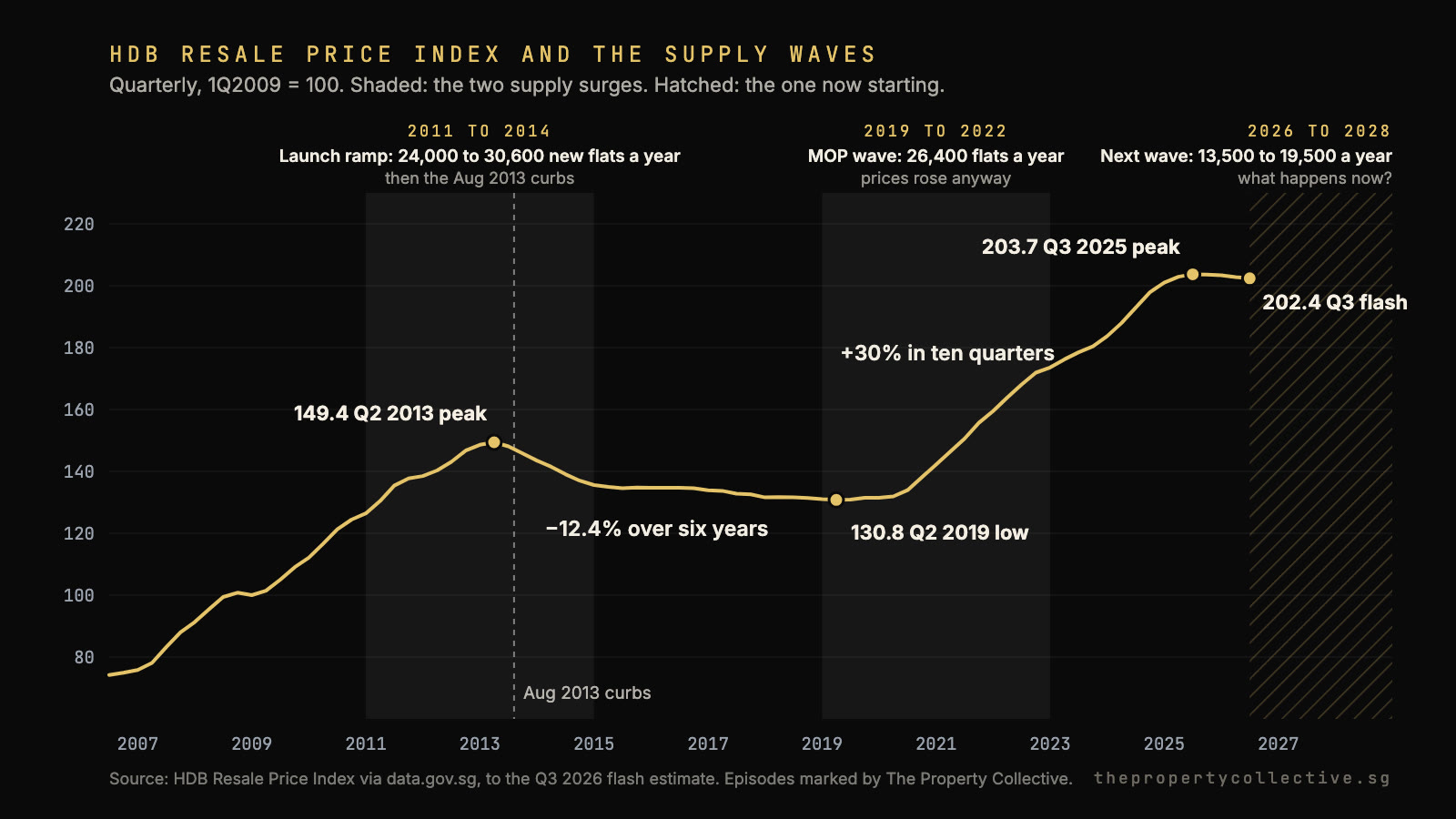
Episode one was the launch ramp of 2011 to 2013, when HDB booked between 24,000 and 30,600 new flats a year, followed by the August 2013 curbs that capped the mortgage servicing ratio at 30%, cut HDB loan tenures to 25 years and made permanent residents wait three years before buying resale. Prices peaked at 149.4 in the second quarter of 2013 and slid for six years, to 130.8 in the second quarter of 2019, a fall of 12.4%. The steepest year was 2014, down 6%.
Episode two was the MOP wave of 2019 to 2022. An average of 26,400 flats a year cleared their MOP, more than triple the 7,800-a-year average of the decade before, and 2022 alone added 30,920. Supply had never been larger. Yet the index rose 30% between mid-2020 and the end of 2022, because the pandemic delayed BTO completions, working from home raised the value of space, and mortgages were close to free. Huttons Asia put it plainly in 2025: the curbs of that period only delayed buyers, and "supply, not restrictions, is the more effective lever". The lever still needs a demand backdrop to pull against.
So what happens to HDB resale prices with more supply in 2027?
Our base case is an index that drifts flat to slightly lower through 2027, with the softness concentrated in the towns where MOP flats cluster and the top of the market still setting records. Three forces push against a sharper fall: the higher income ceiling, the end of the wait-out period, and financing that is still cheap.
Sources: The Straits Times (28 May 2025, 23 Aug 2026); HDB (30 Jun 2026); CNA (18 Sep 2026); The Property Collective.
| Force | Pushes prices | Why it matters |
|---|---|---|
| MOP flats rising from 13,500 to 19,500 a year | Down | More sellers with near-identical flats, in the same towns, at the same time |
| About 24,000 new flats in 2026, 7,960 more in November | Down | First-timers earning up to $16,000 can ballot instead of buying resale |
| Income ceiling raised to $16,000 on 24 August | Up | More households qualify for HDB loans and up to $80,000 in resale grants, per Huttons Asia |
| 15-month wait-out period removed on 28 July | Up | Private owners were 34% of million-dollar buyers before the rule and 12% under it |
| Bank fixed rates still well under 2%, HDB loan at 2.6% | Up | Cheap financing holds budgets up even as the Fed hikes |
| Softer job market and economic uncertainty | Down | HDB itself is warning households to exercise prudence |
The Government is not trying to engineer a fall. Mr Chee’s framing in May 2025 was to "give the market time to adjust to the higher supply of flats after they reach their MOP from 2026". Read literally, that is a plateau policy, not a correction policy, and it is what the first half of 2026 looks like: two small dips, resale volume 10% below a year earlier, and a record 491 million-dollar resales in the same quarter.
The clearest signal is not in the index but in where the supply sits. Nearly a quarter of this year’s MOP flats are in Punggol, and Punggol recorded seven million-dollar deals in the second quarter. Toa Payoh has half as many MOP flats and recorded 66.
Source: EdgeProp (24 Jul 2026), citing PropNex analysis of HDB data. Towns ranked by flats reaching MOP in 2026.
| Town | Flats reaching MOP in 2026 | Share | Million-dollar resales, Q2 2026 |
|---|---|---|---|
| Punggol | 3,222 | 23.9% | 7 |
| Queenstown | 2,405 | 17.8% | 65 |
| Tampines | 2,133 | 15.8% | 27 |
| Toa Payoh | 1,594 | 11.8% | 66 |
| Bedok | 1,440 | 10.7% | 27 |
| Yishun | 456 | 3.4% | 4 |
| Bukit Panjang | 350 | 2.6% | 3 |
| Sengkang | 330 | 2.4% | 4 |
| All towns | 13,480 | 100% | 491 |
That table is the whole argument in one place. Supply lands in the young estates, in flats that are nearly identical to thousands of neighbours. Scarcity lives in the mature and central towns, where the MOP cohorts are older projects on prime sites and the buyer is often a private-property owner who no longer has to wait. Two markets, one index.
Which flats feel the extra supply first?
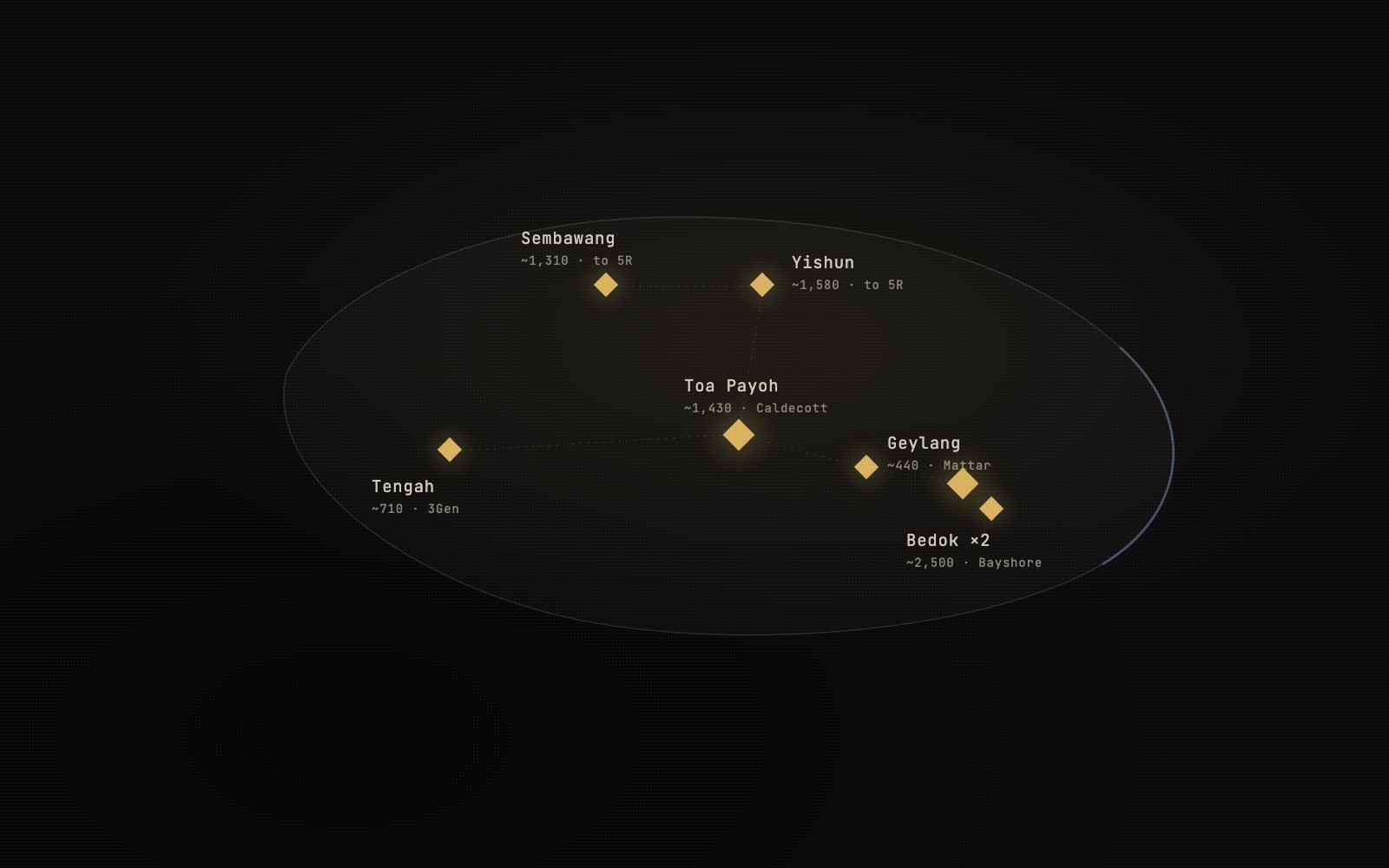
Five-year-old four-room flats in Punggol, Tampines and Sengkang, followed by the 2027 and 2028 cohorts in the same estates. These are the flats with the most direct substitutes: same block plans, same lease, same finishes, listing at the same time. The buyer for that flat is also the buyer the November BTO launch is built for, now that the income ceiling is $16,000, and the 2,500 flats at Bayshore and 1,430 next to Caldecott MRT will pull some of them out of the resale queue for the next four years.
Older flats in mature estates are less exposed to the MOP wave and more exposed to lease decay, which is a different problem with a different fix. The flats least affected are the ones the wave cannot replicate. The Pinnacle@Duxton five-room that sold for $1.72 million on 25 September, a Central Area record, is competing with nothing on the November list.
If you are selling to upgrade, what should you do?
We covered the order of operations in sell first or buy first, the tax side in ABSD when upgrading, and the arithmetic of a slow market in the upgrader window. The supply wave makes all three more important, not less.
If you are buying a resale flat, does waiting pay?
For a young flat in Punggol, Tampines or Queenstown, yes: choice improves through 2027 and 2028 and pricing power shifts to you. For a scarce central flat, no: the wave does not reach it, and the private-property buyers freed by the end of the wait-out period are already there. Either way, budget at today’s rates plus a margin, because the Fed is not done, and remember that resale grants of up to $80,000 for eligible first-timers have no equivalent in the private market.
What the 1 October flash said
Updated 1 October 2026. HDB’s third-quarter flash came in at 202.4, down 0.2%, the third straight quarterly dip and a cumulative 0.6% since the Q3 2025 peak. Resale volume rose 17.7% on the quarter to 7,528 deals, so the first MOP cohort is being absorbed at slightly lower prices rather than sitting unsold, which is what our flat-to-slightly-lower base case expected. One correction to what we wrote before the print: the run of declines is now the longest since the four quarters to mid-2019, not since 2014. We unpack the number, the private-market contrast and the analyst calls here. The town split arrives with HDB’s full quarterly data in late October; we will add it then.
Sources
- HDB: Flash Estimate of 2nd Quarter 2026 Resale Price Index and Upcoming Flat Supply (30 Jun 2026)
- data.gov.sg: HDB Resale Price Index, quarterly (1Q2009 = 100)
- The Straits Times: Higher BTO, resale flat demand expected after income ceiling raised, but supply can keep up (23 Aug 2026)
- The Straits Times: New National Development Minister to prioritise HDB flat affordability, supply (28 May 2025)
- The Business Times: Public housing with million-dollar price tags (6 Oct 2022)
- The Business Times: HDB resale prices set to continue growth streak in 2025
- EdgeProp: HDB resale prices fall for second consecutive quarter, down 0.3% in 2Q2026 (24 Jul 2026)
- EdgeProp: Why BTO supply, not curbs, is key to cooling HDB resale prices (24 Jul 2025)
- EdgeProp: Five-room flat at Pinnacle@Duxton sets record of $1.72 mil (Sep 2026)
- MND: Closing speech by Minister Desmond Lee for the parliamentary motion on affordable and accessible public housing
- CNA: Property cooling measures likely to push up rents (Aug 2013)
Selling an HDB flat into the supply wave, or timing an upgrade around it? We read your block, your town and your next purchase against the numbers, not the headlines.
Keep reading
Related notes.
Three quarters down, 0.6% in total. What HDB’s Q3 flash really says about resale prices.
HDB’s flash estimate puts the Q3 2026 Resale Price Index at 202.4, down 0.2% and the third straight quarterly dip, while URA’s private index jumped 1.4%. Volumes rose 17.7%, million-dollar flats hit 597, and the gap between an HDB flat and the condo it is meant to fund widened again. Here is what the number does and does not mean.
Private prices up 0.5%. HDB down 0.3%. Why cooler is the decision window, not a dead end.
Private prices crawled in Q2. HDB slipped for a second straight quarter. Yet 6,396 resale flats still changed hands, and the 15-month wait-out just came off. Selectivity is the operating system now. That is a decision window, not a dead end.
The November BTO guide: 7,960 flats, six towns, and a deadline in September.
About 7,960 flats across Bedok, Geylang, Sembawang, Tengah, Toa Payoh and Yishun, in the first exercise under the $16,000 income ceiling. The paperwork deadline lands 25 September, and the ballot maths this round is stranger than it looks.
Figures move. Index values are HDB data as at 1 October 2026, including the Q3 2026 flash estimate of 202.4; the Q2 flash of 202.7 was finalised at 202.8. MOP counts for 2027 and 2028 are projections reported by The Straits Times and may be revised.
Not financial advice. This is market commentary, not a recommendation to buy or sell. Speak to us or your own adviser about your situation.
Independent. The Property Collective is not paid by any developer, bank or portal named here.