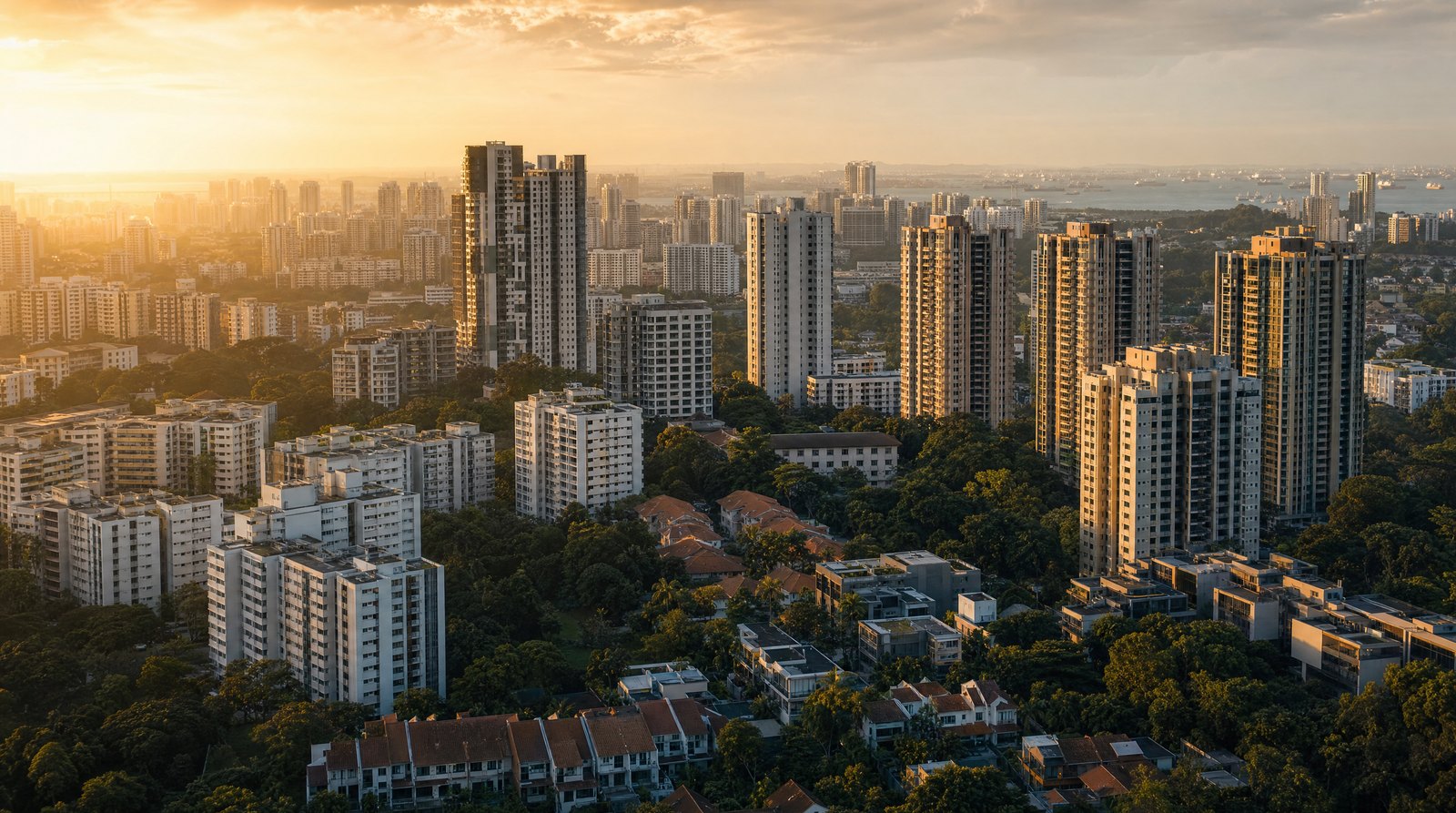
The gap between a good condo buy and a costly one is rarely the headline price. It’s usually timing, project choice and exit logic. So the Singapore condo market deserves a sharper read than the usual cycle chatter about launches, cooling measures and interest rates.
If you’re a buyer, upgrader or owner thinking in five- to ten-year horizons, the market isn’t simply moving up or down. It’s repricing by segment, district, tenure and buyer profile. The useful question isn’t whether the market is strong — it’s where value is still rational, where risk is being underpriced, and which projects will hold their footing when the cycle turns.
The market no longer moves as one
The clearest shift of recent years: the condo market has turned selective. Broad appreciation still shows up in the data, but not every project shares it. The gap between the strong performers and the laggards has widened.
You can see it in the headline numbers. In Q1 2026, URA’s private price index rose 0.9% overall — but the suburbs (OCR) gained 2.2% while the prime core (CCR) managed just 0.6%, more than three times the pace, in a single quarter. The “market” isn’t one number, and it hasn’t been for a while.
That matters, because plenty of buyers still treat private property as if the whole segment moves together. It doesn’t. New-launch demand, resale resilience, rental support and future exit liquidity are diverging more sharply than before. A compact unit in a tightly held, well-connected project can out-perform a larger unit in a less efficient development — even in the same district.
In plain terms: project-level analysis now matters more than broad-market optimism. Lean on district reputation alone and you can still overpay. Assume every condo enjoys the same uplift and you can misjudge your timing.
Prices are firm, but affordability is doing the real work
The easy read is “prices are high because demand is strong.” Partly true, but it misses the mechanism. Prices are being held up by constrained supply in certain segments, accumulated household wealth, and a buyer pool that has grown more equity-rich over time.
At the same time, affordability has tightened. Higher prices and elevated financing costs have changed what buyers can comfortably hold. That’s why unit efficiency matters more now — layout, total quantum and maintenance burden get closer scrutiny, because buyers aren’t only stretching to get in. They’re stress-testing the hold.
For HDB upgraders, this is the heart of it. The move into private is often framed as a milestone; the better frame is a portfolio transition. The question isn’t only “can I buy?” — it’s whether the next asset leaves enough flexibility for future progression, family needs and an eventual exit.
New launches set the benchmark; resale is where the nuance sits
New-launch activity shapes sentiment because it resets expectations. When developers get strong take-up at elevated psf, nearby resale often rides the psychological anchor — buyers start comparing age, location and usable space against the new number rather than against past resale deals.
But resale is the more nuanced part of the market, and that’s where pricing inefficiencies still live. A resale project with strong land value, a sound unit mix and reliable transaction depth can offer a better risk-adjusted entry than a launch bought at a premium to future assumptions.
The trade-off is simple. New launches offer fresh product, deferred completion and low early maintenance. Resale offers larger layouts, clearer rental evidence and a visible price history. Which wins depends on your objective, holding period and capital structure — not on which category sounds better.
Supply is never just a headline number
Pipeline supply gets a lot of airtime, but it only means something through the lens of location, affordability and competing stock. A big incoming-unit count doesn’t automatically soften prices everywhere. What matters is whether a submarket is getting directly substitutable inventory.
The scale is real — roughly 38,000 unsold units sat in the pipeline at the start of 2026, and new-sale take-up fell about 31% in Q1 even as prices held — but it bites locally, not nationally. A mature city-fringe cluster with little future land to release can stay resilient even in a heavy launch year. An area with several comparable projects completing around the same time can face temporary price friction and rental competition.
This is where buyers misread the data — seeing aggregate supply and assuming broad downside, or low national vacancy and assuming broad safety. Neither is precise enough. A condo competes locally, not nationally.
Rates changed behaviour more than intent
Higher rates didn’t kill demand — they filtered it. Buyers got more selective, more payment-conscious, and less willing to pay up for weak attributes. That’s a healthy adjustment.
By 2026, borrowing costs had eased sharply — three-month SORA down to around 1–1.5%, roughly half its early-2025 level — yet cheaper money hasn’t brought back indiscriminate buying. Cheap debt is no longer doing the heavy lifting; equity position matters more. Buyers with stronger cash and CPF buffers can act decisively, while overextended ones have less room for error. The advantage has shifted to households that plan before they transact.
It also raises the value of scenario planning. Test a purchase against different rate paths, family cash-flow needs, rental assumptions and exit timelines. In a market with elevated prices, margin of safety isn’t found in hope — it’s built through structure.
Rental supports private housing, but not every yield story is equal
Rental growth gave owners confidence these last few years, but it isn’t a permanent condition. Rental markets can normalise even while prices hold — and they have: URA’s private rental index edged up just 0.3% in Q1 2026, essentially flat. So separate short-term rental strength from long-term asset quality.
Projects near employment nodes, transit and established amenities tend to keep tenant appeal. Even so, yield is only one part of performance. Tenants can cover your holding costs while weak future resale demand still caps your total return.
For investors, the sharper question is whether a project has both rental resilience and clean future liquidity. A unit that rents well but is hard to sell at the right moment isn’t a complete asset. Cash flow matters; exit depth matters just as much.
Buyers are getting more analytical
Another real shift is behavioural. Serious buyers now ask sharper questions — not just average psf, but profitable-transaction ratios, entry timing, seller competition, how a specific stack performs, and how a project compares with its neighbours.
That’s a more mature market. It reflects that private property is no longer judged purely on lifestyle appeal — it’s assessed as a capital decision with compounding effects.
This is exactly the gap BuySafe was built to close — our in-house tool for resale private condos. It reads 140,000+ publicly available URA transactions across 3,000+ projects and uses a hedonic regression (the same family of methods behind official house-price indices) to estimate real, like-for-like price growth, with each project carrying one 0–100 score. Where the data is too thin to trust, it shows a blank instead of a confident guess. So instead of debating whether a district is “good,” you can see which projects in it have genuinely held value and exit cleanly — and which are priced on reputation alone. Know the exit before you enter.
None of that removes emotion — homes are personal. But better outcomes come when emotion sits inside a disciplined structure. You can love a project and still ask whether the tenure, layout, surrounding supply and future buyer pool support the decision. That’s not hesitation; it’s stewardship.
What this means for the next few years
The market is unlikely to reward lazy selection — that’s the takeaway. Price momentum can persist, especially in well-located, supply-constrained segments, but the easy gains from simply owning any condo are less dependable than many assume.
Expect more segmentation. Expect well-executed projects in strong locations to keep pricing power. Expect weak developments, compromised layouts and overambitious entry prices to meet more resistance. If rates ease and sentiment improves, that still won’t erase the gap between quality assets and average ones.
For upgraders, this is a season to plan, not rush. The best move might be immediate entry, a delayed purchase, or a staged progression — depending on your equity, loan capacity and the cost of waiting (more on getting the timing right). For owners, the question isn’t “should I sell because prices rose?” — it’s whether your current asset still serves the next stage of your portfolio.
At The Property Collective, that distinction is the whole game. Decisions hold up better when they’re mapped against future options, not just present desire. The market will keep moving — but not all movement is progress. The edge belongs to buyers and owners who read it at project level, keep their flexibility, and treat every purchase as one chapter in a longer balance-sheet story.
Next: how to assess condo entry timing →
Sources
The market rewards project-level selection now, not broad optimism. We map the segment, the project and the exit with you, and bring the data the headlines can’t.
Keep reading
Related notes.

Six quarters of muted growth: is this the upgrader’s window, or a trap?
Private prices have grown at 1% or less for six straight quarters, and HDB resale has now fallen two quarters in a row. That combination is unusual, and it changes the arithmetic of upgrading in a way most sellers have not noticed yet.
The three forces that decide whether waiting pays: capital, rates and replacement cost.
Most buyers are waiting for one number to fall: the price. But three forces sit underneath every price in this market, and right now all three point the same way. Here is the framework, the data behind each force, and the honest case for waiting anyway.

Singapore micro-district property trends: same postcode, different outcomes.
Two condos can share a district number, launch months apart, and still diverge by years of gains. The edge has moved from district branding to pocket selection, here’s how to read it.
Not financial or tax advice. General information about the Singapore private property market. It is not financial, investment, tax, mortgage or legal advice, and not a recommendation to buy, sell or hold any property. Your position depends on your own circumstances.
Rules change. ABSD, TDSR, loan-to-value limits and CPF rules are set by IRAS, MAS, HDB and the CPF Board and can change without notice. Figures here are general guidance as at 2026 — confirm your exact position with the relevant authority and your own advisers before committing.
Independent. The Property Collective is not affiliated with, endorsed by, or connected to IRAS, MAS, HDB, the CPF Board, the URA or any government agency. BuySafe analyses resale private condos using historical, publicly available URA transaction data and does not cover new launches; past performance is not indicative of future results.