At the National Day Rally on 23 August, Prime Minister Lawrence Wong raised the monthly household income ceiling for BTO flats from $14,000 to $16,000, and for executive condominiums from $16,000 to $18,000. Singles aged 35 and above go from $7,000 to $8,000. All of it takes effect on 24 August, and it is the first adjustment since 2019. The reaction will be that the government has loosened access. The more useful question is by how much, measured against what has happened to household incomes over the same seven years, and the answer is that this closes about half the gap rather than all of it.
Sources: The Business Times and the MND and HDB joint release, 23 August 2026; SingStat household income series.
What exactly changed at the National Day Rally?
Four things. The BTO household income ceiling rises to $16,000, the EC ceiling to $18,000, and the ceiling for singles aged 35 and above buying a subsidised flat or taking an HDB loan rises to $8,000. Separately, from the February 2027 exercise, first-timer families get one extra ballot chance for every Singaporean child aged 18 or below, including a child on the way, across BTO and Sale of Balance Flats. The next BTO exercise has also been pushed from October to November 2026, about 7,960 flats across Bedok, Geylang, Sembawang, Tengah, Toa Payoh and Yishun, specifically so buyers have time to apply for an HFE letter under the new ceilings.
One detail in the BTO change is worth pulling out, because it is doing more work than the headline suggests. The $16,000 ceiling governs the HDB Flat Eligibility letter, and that letter is not only for buying a new flat. It also governs whether you qualify for the CPF Housing Grant on a resale flat, and whether you can take an HDB housing loan at all. So this is not purely a BTO measure. It widens grant and loan access for every household between $14,000 and $16,000, whichever side of the market they buy on.
Does the higher EC ceiling help anyone buying an EC now?
Almost nobody, and this is the part most coverage will skip. The $18,000 ceiling applies only to new units in ECs whose land sale tender closes on or after 24 August 2026. It explicitly does not apply to balance units in existing ECs, and it does not apply to new ECs on sites already awarded before that date. Every EC you could walk into a showflat and buy today still runs on the old $16,000 ceiling, and so does every EC coming from land already in developers’ hands.
Work the timeline forward. A site whose tender closes after 24 August is awarded a few weeks later, then designed, approved and built toward a launch that historically lands somewhere between one and two years after award. That puts the first EC actually sold under the $18,000 ceiling in late 2027 at the earliest and 2028 on any realistic reading. A household earning $17,000 today is not an EC buyer this year or next. They are an EC buyer in two years, if their income has not moved again by then.
That matters more because of what else changed this year. The EC minimum occupation period doubled to ten years and the deferred payment scheme was scrapped, which we covered in the 2026 EC rule changes. A higher ceiling arriving in 2028 does not offset a ten-year lock-in arriving now, and anyone treating the two as cancelling out has the timing wrong in both directions.
How much ground does this actually make up?
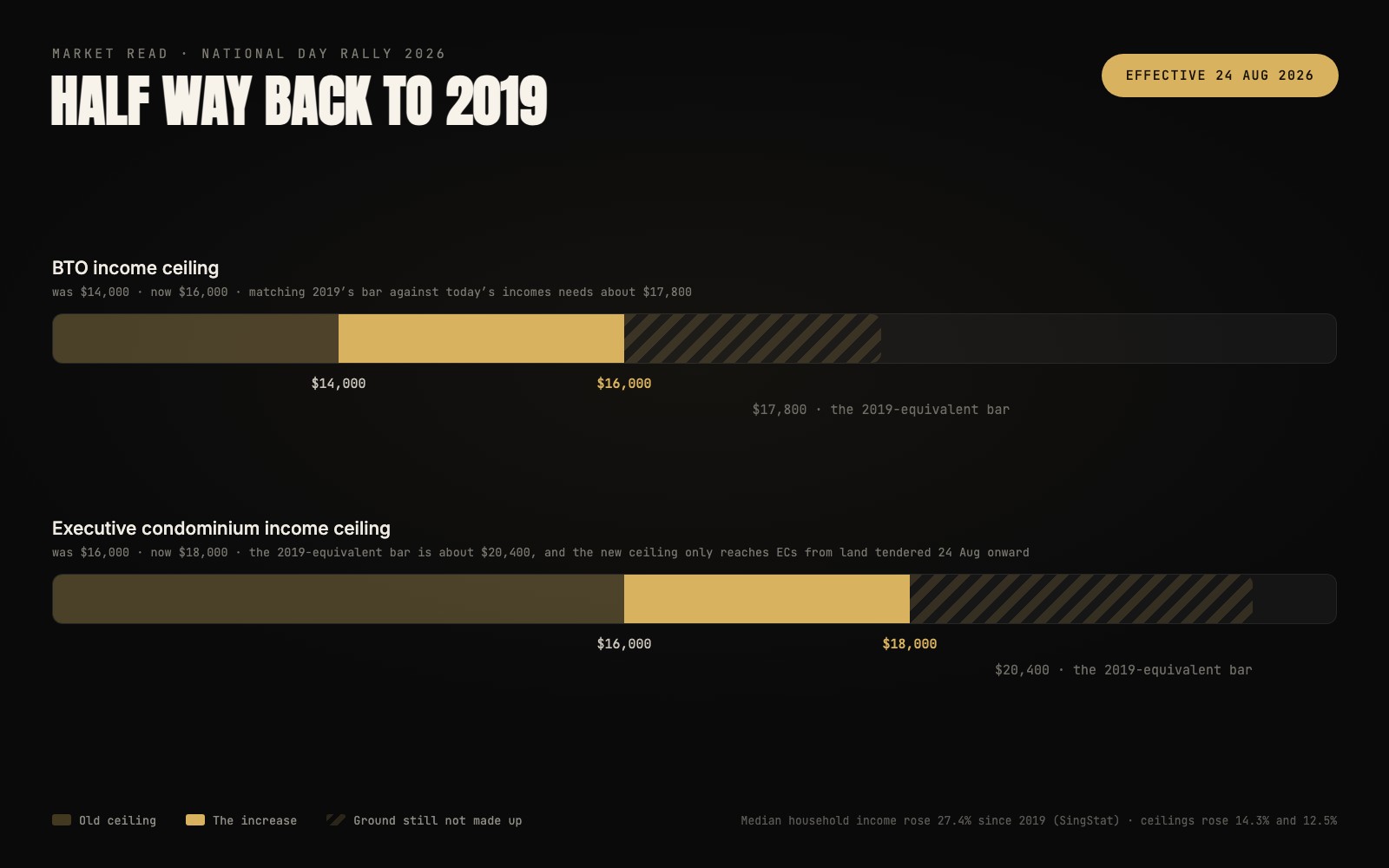
About half. The ceilings were last set in 2019, when median monthly household employment income including employer CPF was $9,442. By 2025 that figure was $12,027, a rise of 27.4%. The BTO ceiling has just risen 14.3% and the EC ceiling 12.5%. Incomes, in other words, grew roughly twice as fast as the ceilings have now been adjusted to catch up with them.
Ceiling as a multiple of median monthly household employment income including employer CPF. Income figures from SingStat; ceilings from MND and HDB.
| Ceiling | Set in 2019 | From 24 Aug | To match 2019 today |
|---|---|---|---|
| BTO, families | $14,000 | $16,000 | about $17,800 |
| Executive condominium | $16,000 | $18,000 | about $20,400 |
In 2019 the BTO ceiling sat at 1.48 times median household income. At $16,000 against 2025 incomes it sits at 1.33 times. The increase is real, and it still leaves the bar tighter than it was seven years ago.
None of which makes the move wrong. Pegging a subsidy ceiling to income growth in full would widen the subsidised pool every single year, which is a policy choice rather than an accounting exercise. But it does mean the honest description is a partial catch-up, not a loosening. If your household sits between $16,000 and $17,800, you are in the group that would have qualified on 2019’s terms and still does not qualify on today’s.
Does a higher BTO ceiling help or hurt the HDB resale market?
It pushes in both directions at once, which is why the early commentary will sound contradictory. Realion’s Christine Sun makes the diversion argument: a wider BTO pool pulls some households who would have bought a larger resale flat into the new-flat queue instead, softening demand at the upper end of resale. That is real, and it is the effect most people will lead with.
The offsetting effect is the one buried in the HFE detail above. Households between $14,000 and $16,000 have just become eligible for the CPF Housing Grant on a resale flat and for an HDB loan. Some of them will not wait three or four years for a BTO. They will take the grant and buy resale now. So the same policy removes some resale demand at the top and adds some at the grant-eligible end, and the net effect on the direction of the HDB resale market is far less obvious than a one-line take suggests.
What should you do differently this week?
The measure that will move the most households is not the EC headline. It is the quiet extension of grant and loan eligibility to a band of earners who were shut out of both, on a market where they can act immediately rather than in 2028.
Work out which route actually fits your numbers →
Sources
- The Business Times: NDR 2026, BTO income ceiling to go up to S$16,000; executive condos ceiling to S$18,000
- HDB: Eligibility to buy a new flat, income ceiling and HFE letter
- SingStat: Key indicators on household employment income among resident employed households
- Prime Minister’s Office: National Day Rally 2026
Sitting just above or just below one of these ceilings, or weighing an EC against a resale flat or a condo? The eligibility line is the easy part. We map what each route does to your cash, your CPF and your exit before you commit to any of them.
Keep reading
Related notes.
Three quarters down, 0.6% in total. What HDB’s Q3 flash really says about resale prices.
HDB’s flash estimate puts the Q3 2026 Resale Price Index at 202.4, down 0.2% and the third straight quarterly dip, while URA’s private index jumped 1.4%. Volumes rose 17.7%, million-dollar flats hit 597, and the gap between an HDB flat and the condo it is meant to fund widened again. Here is what the number does and does not mean.

More flats are coming. What the 2026 to 2028 supply wave does to HDB resale prices.
HDB resale prices have fallen two quarters in a row, and the flats reaching their five-year MOP rise from about 13,500 this year to 19,500 in 2028. History says supply caps the upside but demand sets the direction. Here is where the softness lands first, and what it means if you are selling to upgrade.

Private prices up 0.5%. HDB down 0.3%. Why cooler is the decision window, not a dead end.
Private prices crawled in Q2. HDB slipped for a second straight quarter. Yet 6,396 resale flats still changed hands, and the 15-month wait-out just came off. Selectivity is the operating system now. That is a decision window, not a dead end.
Figures are official, the comparison is ours. The ceilings, effective dates and ballot changes are from the MND and HDB joint release of 23 August 2026 as reported by The Business Times. Median household employment income including employer CPF is from SingStat’s resident employed households series. The comparison between ceiling growth and income growth, and the implied 2019-equivalent ceilings, are our own arithmetic from those published figures, not a government calculation. The EC launch timeline is our estimate from typical tender-to-launch periods, not an announced schedule. This is general information, not advice on your circumstances.