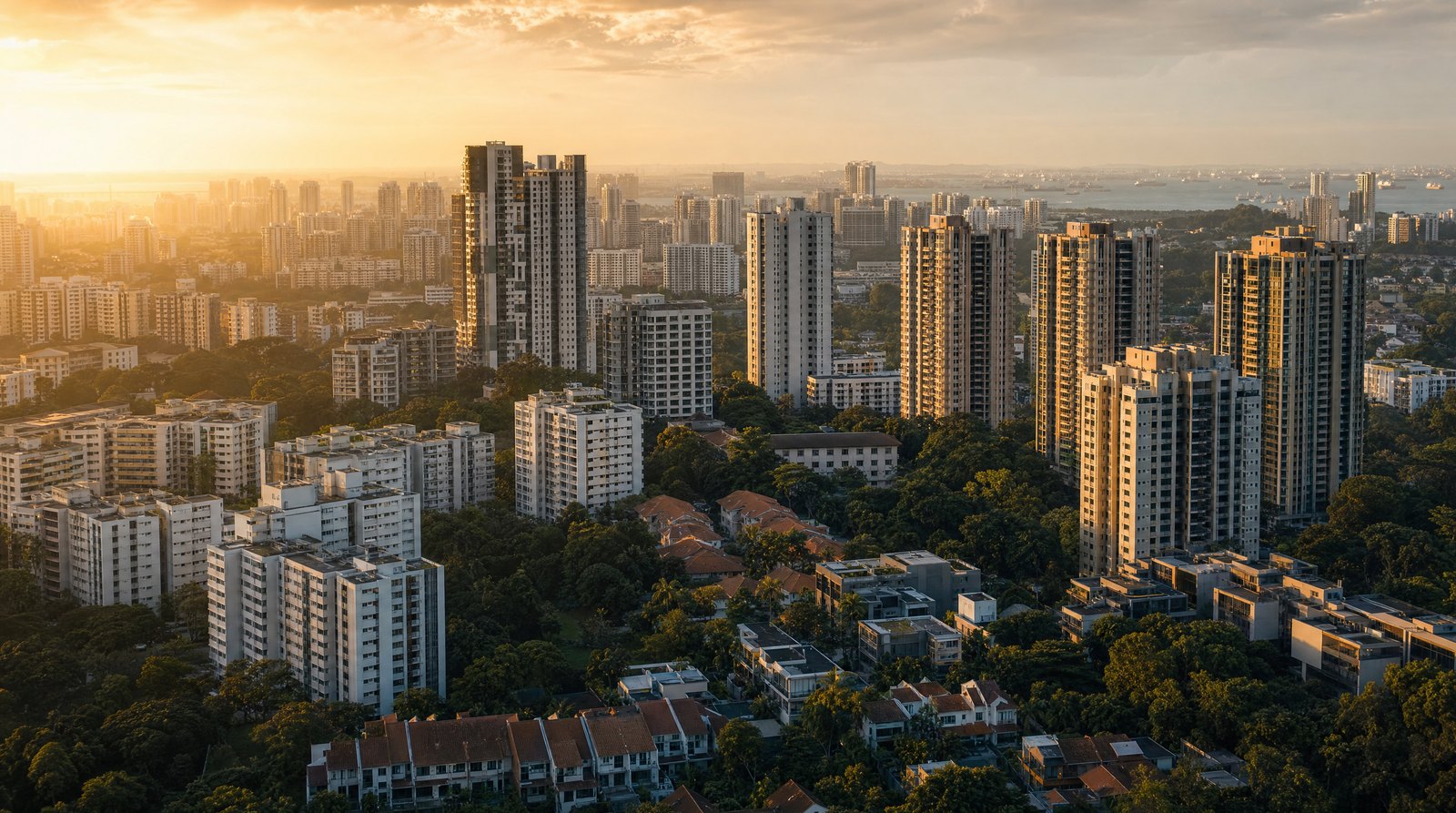
Every buyer we meet is waiting for the same thing: a better price. It is a reasonable instinct, and sometimes it is right. But price is an output, not an input. Underneath it sit three forces, and if you can read those, you can judge whether waiting is patience or procrastination. The framework comes from PropNex chief executive Kelvin Fong, who set it out at the August 2026 sales briefing: capital and wealth, interest rates and demand, and supply and replacement cost. We have taken those three, checked them against the public data, and added the part a sales briefing will not: the case for waiting anyway.
Sources: URA Q2 2026 statistics, MAS SORA data, PropNex Research. Figures as at Q2 and July 2026.
Force 1: does the stock market move property prices?
Indirectly, and with a lag. Property does not move in isolation from the rest of the wealth cycle. When equities run, some of that capital eventually looks for a harder asset, and in Singapore that has historically meant private homes. PropNex traces new-sale psf against the Straits Times Index over three decades, and the pattern is consistent: the Asian Financial Crisis, SARS, the Global Financial Crisis and Covid each produced a paired drawdown, and each recovery produced a paired run, with property lagging equities rather than leading them.
That lag is the useful part. It means a strong equity market is not a signal to buy property today at any price, but it does tell you which direction the tide is running, and it argues against the assumption that a soft price index means demand has gone away. Money that has been made elsewhere tends to arrive here later.
Force 2: should you wait for interest rates to fall further?
Most of the fall has already happened, which weakens the case for waiting. This is the force most buyers are actually waiting on, and it has already moved a long way. The 3-month compounded SORA has fallen from roughly 2.95% in January 2025 to around 1.1% by mid-2026, with fixed-rate packages tracking down to the 1.3% to 1.5% region over the same stretch. On a $1.5 million loan over 25 years, the difference between roughly 3% and roughly 1.5% is in the region of $1,000 a month. That is not a rounding error; it is the single largest change in the cost of buying since the last cycle.
3-month compounded SORA, approximate month-end levels. Source: MAS, via PropNex Research.
The steep part of the fall is behind us. From here the question is not how much cheaper money gets, but who else shows up when it does.
Here is the trap in waiting for rates. Cheaper money does not only lower your repayment, it lowers everyone else’s. Rates are a demand lever, so the same cut that improves your affordability also brings the buyers who were priced out back to the same showflats and the same resale listings. If you wait for the next cut, you may well get it, and you may find you are bidding against a larger crowd for the same unit. The saving on the loan and the premium on the price move in opposite directions.
Force 3: can future homes actually become cheaper?
Not easily, because tomorrow’s home cannot be built for less than the land it sits on. This is the force buyers most often ignore, and it is the most concrete of the three. Unsold private stock has fallen to 14,929 units as at Q2 2026, and at recent average sales rates that is roughly 1.2 years of supply in both the city fringe and the suburbs. At the same time, the average winning land rate for government residential sites has climbed from about $724 psf per plot ratio in 2013 to about $1,428 in 2026.
Average GLS residential land rates and average new-launch prices. Source: PropNex Research, URA Realis, data to July 2026.
| Year | Avg land rate (psf ppr) | Avg new-launch price (psf) |
|---|---|---|
| 2013 | $724 | $1,406 |
| 2019 | $1,167 | $1,670 |
| 2023 | $1,147 | $2,314 |
| 2026 | $1,428 | $2,592 |
Land is the floor under a launch price, and that floor has risen about 97% since 2013. A developer who pays today’s land rate cannot launch at yesterday’s price.
Put the three together and the argument is not that prices must rise. It is narrower and more useful than that: the conditions that would make a future purchase cheaper are the same conditions that would bring competing buyers back, and the cost floor beneath new supply keeps rising regardless. That is why we read this as a window rather than a bottom.
When is waiting the right call?
When the reason is personal rather than a bet on the price index. A briefing that only makes the case to buy is a sales pitch, so here is the other side, and it is real. Waiting is the right call more often than the market likes to admit.
What we would not do is wait purely for a lower headline price while the three forces run the other way. That is not a strategy, it is a hope, and it usually ends with a buyer paying more for a worse choice of stock in a busier market.
How do you decide whether to buy or wait?
Answer four questions honestly, in this order. If the first three point the same way, the fourth usually settles it.
That last question is the one we come back to. Our BuySafe engine exists for exactly this: a size- and floor-adjusted read of how a project’s resale market has really behaved, built from more than 140,000 publicly available URA transactions across 3,000+ private condo projects, so the exit is a number rather than a hope. It scores resale private condos and does not score new launches. Know the exit before you enter.
Next: how to assess entry timing on a specific project →
Sources
Waiting is a position, not a pause. Before you hold another six months, we pressure-test what your wait actually costs you: the rate you could lock, the stock you can still choose from, and the exit on the home you would be buying.
Keep reading
Related notes.

Six quarters of muted growth: is this the upgrader’s window, or a trap?
Private prices have grown at 1% or less for six straight quarters, and HDB resale has now fallen two quarters in a row. That combination is unusual, and it changes the arithmetic of upgrading in a way most sellers have not noticed yet.
Singapore condo market trends that matter.
The market isn’t simply up or down, it’s repricing by segment, district and buyer. The trends that decide whether your condo holds its value, and exits cleanly.

Singapore micro-district property trends: same postcode, different outcomes.
Two condos can share a district number, launch months apart, and still diverge by years of gains. The edge has moved from district branding to pocket selection, here’s how to read it.
Not financial advice. This is general commentary for informational purposes only. It is not financial, investment, mortgage, legal or tax advice, and not a recommendation to buy, sell or hold any property, or to take on any loan. Interest rate levels and market conditions change; your position depends on your own circumstances and a lender’s assessment.
Figures are indicative. Price index, unsold stock and land-rate figures are from URA and PropNex Research as at Q2 and July 2026 and are rounded for readability. SORA levels are approximate month-end figures from MAS data. The illustrative repayment comparison is a simple example, not a quote. Past performance is not indicative of future results.
Independent, and about BuySafe. The Property Collective is a team within PropNex Realty and is not affiliated with, endorsed by, or connected to URA, MAS or any developer. The three-forces framework is credited to PropNex chief executive Kelvin Fong; the data checks, analysis and conclusions here are our own. BuySafe analyses resale private condos using historical, publicly available URA transaction data and does not score new launches.